
China’s Paramilitary Wall Rises Against Vietnam Around the Paracel Islands

Ray Powell
Share


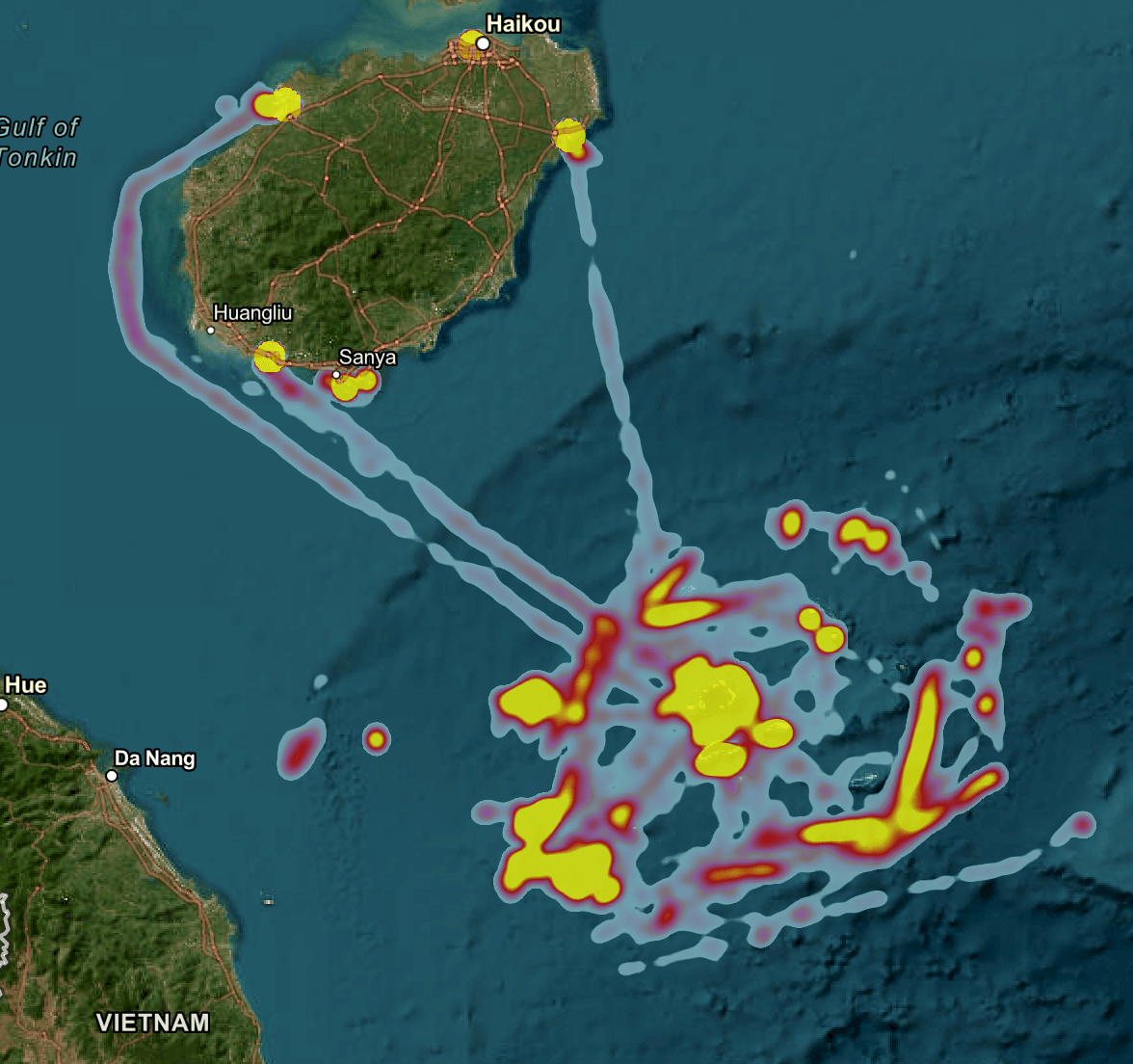
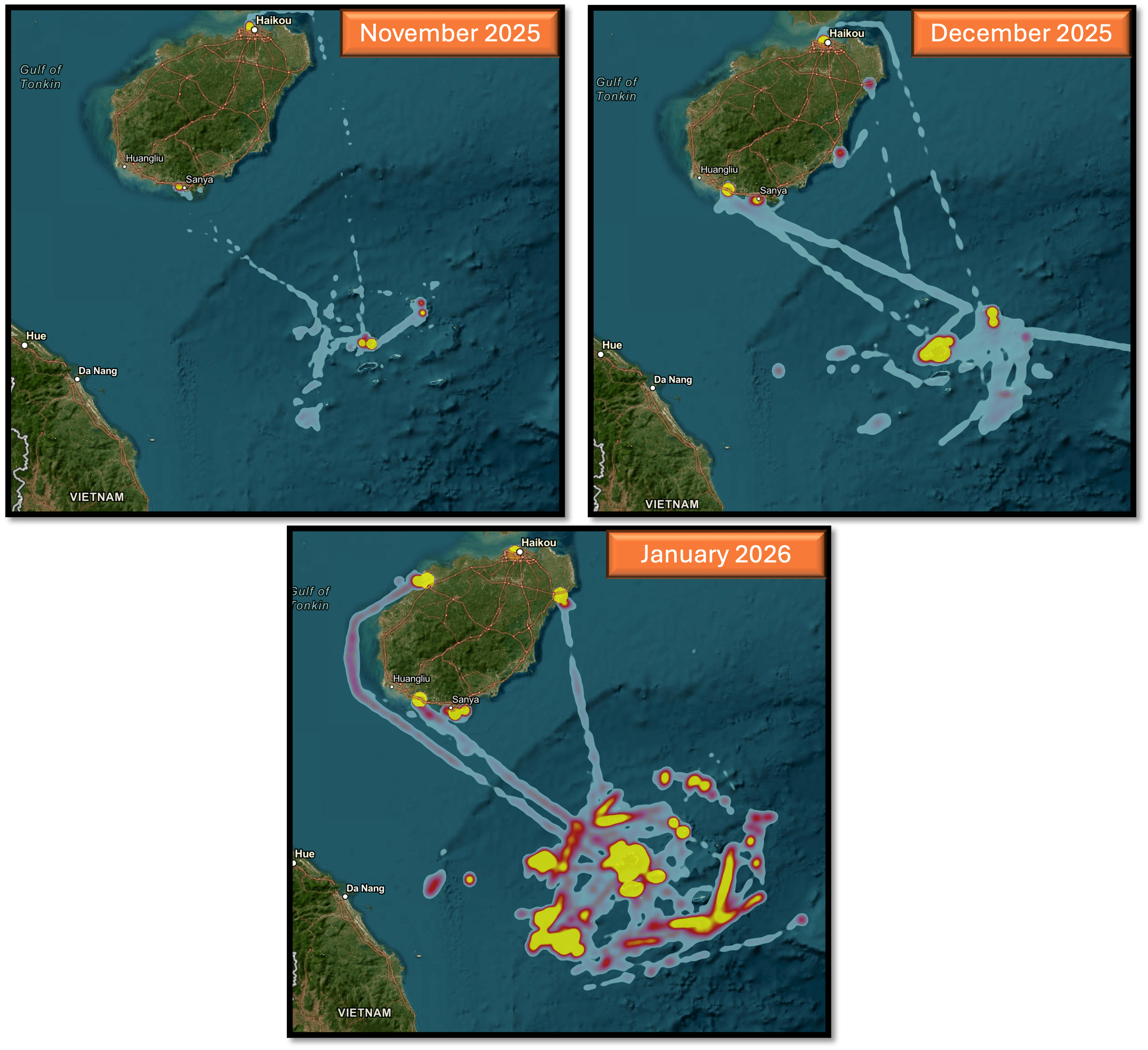
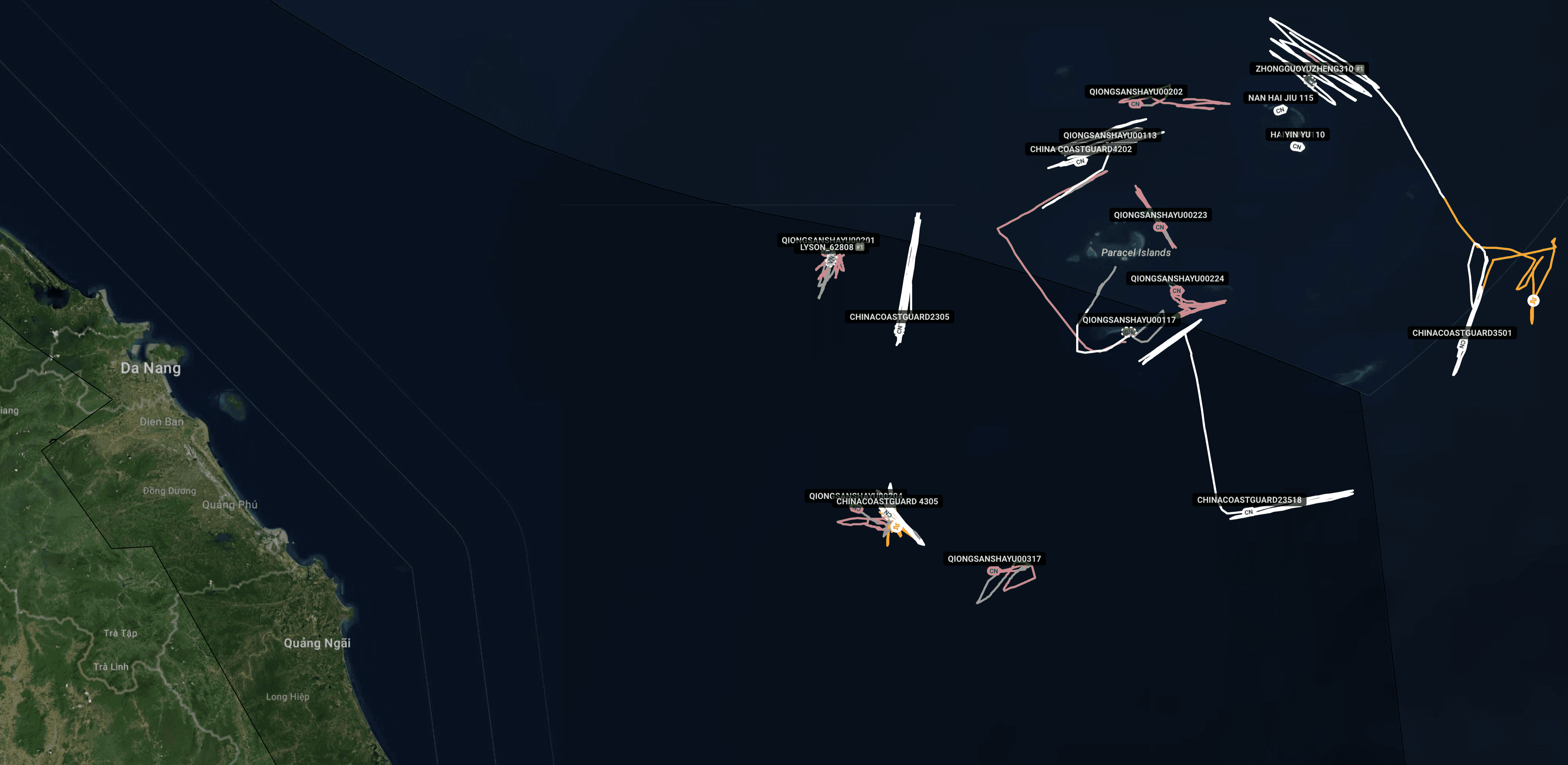
Since December 2025, China has quietly fortified the Paracel Islands with a thickening wall of coast guard, maritime militia and other security vessels, turning what was once a relatively static law‑enforcement presence into a layered paramilitary cordon around the disputed archipelago. Automatic Identification System (AIS) tracking from Starboard Maritime Intelligence shows China Coast Guard cutters, Sansha law enforcement and maritime safety ships and, for the first time in recent memory, large maritime militia vessels operating together around the archipelago. Most of this activity is concentrated around the western Crescent Group nearest Vietnam, in an apparent bid to block all Vietnamese patrols and fishing activity from the area.
This surge coincides with a major PRC dredging and land reclamation campaign at Antelope Reef, also in the Crescent Group. While most of the ships working this project have gone “dark” by switching off their AIS transponders, commercial satellite imagery tells a different story: dozens of cutter‑suction dredgers carving channels through the reef, pumping sand and coral onto emerging platforms and reshaping this atoll into what will likely be yet another fortified outpost.
For Vietnam, this new wall of sand and ships is more than just a symbolic show of force around an island group it also claims. Vietnamese fishing boats that have traditionally worked the waters around the Paracels increasingly face a multi‑layered exclusion zone. In recent months, only a handful of Vietnamese vessels -- primarily Ly Son–based maritime militia boats -- have been visible on AIS trying to approach the area, but these find themselves vastly outnumbered by the robust Chinese force now there.
A New Layer in a Long Campaign
This most recent push to consolidate control overt the Paracels is over five decades in the making. In January 1974, Chinese naval forces seized the Crescent Group from South Vietnam's collapsing regime after a brief but violent clash. Since then, Beijing has patiently tightened its grip, first turning Woody Island into a heavily militarized hub with a 2,700-meter runway, hardened aircraft shelters, advanced air defenses and permanent garrisons. From this and other outposts, China has steadily extended its administrative reach via its Woody-based Sansha City government unit and its paramilitary reach via the China Coast Guard, prefecture law enforcement and maritime militia ships.
In recent years, that consolidation has increasingly taken the form of direct pressure on fishermen. Vietnamese boats operating near the Paracels have reported boardings, rammings, detention and even physical assaults by Chinese officers, who seem determined to end all forays into waters Beijing clearly believes should no longer be considered "disputed".
Triton Island: From Coral Outcrop to Sensor Node
Before Antelope Reef, the most visible recent phase of this consolidation campaign was centered on Triton Island, located at the southwestern edge of the Crescent Group and just 120 nautical miles from Vietnam’s coast. Over the past two years, satellite imagery has documented an aggressive construction push there, though early speculation about airfield construction proved erroneous.
Analysts have instead identified a large, distinctive radar complex on Triton that appears to be a key node in China’s growing counter‑stealth network. Additional structures on the island are consistent with signals intelligence, coastal defense and logistics functions, transforming Triton into the Paracels' southwestern military and sensor hub.
Antelope Reef: Now Under Construction
The newest frontier in this build-out is Antelope Reef, until recently a mostly submerged feature in heart of the Crescent Group. That began to change in December 2025, when a fleet of Chinese dredgers left ports near the Pearl River estuary, gradually switching off their AIS signals as they made their way south. Satellite imagery soon revealed their destination.
Over the weeks that followed, this imagery has shown 20‑plus cutter‑suction dredgers grinding up Antelope Reef and pumping the slurry into growing landforms. Channels have been cut through shallow sandbars, large sheltered basins are taking shape and straight, quay‑like edges are emerging -- all hallmarks of other naval and coast‑guard harbors China has built elsewhere in the South China Sea. Analysts estimate that thus far reclamation activities have transformed roughly 15 square kilometers of the reef into a mix of new land and dredged basins.
China's objective for Antelope Reef seems to be a large artificial platform built around a deepened lagoon, with a purpose‑built harbor and extensive flat pads for future infrastructure. The layout closely resembles China’s earlier island‑building projects, with straight quay walls, a sheltered basin and an access channel suitable for warships, coast guard vessels and large maritime militia trawlers, though it is too early to say exactly which weapons or sensors will be installed.
Paramilitary Cordon: The Militia & The Monster
It is against this backdrop that the recent paramilitary buildup takes on its full significance. Beginning on 2 December -- just before the Antelope Reef dredging began -- a flotilla of seven PRC maritime militia arrived in the Paracels to augment the longstanding coast guard and law enforcement force already there. Several of these ships then moved west, substantially thickening China's cordon against Vietnamese intrusion.
In another surprise development, the following month SeaLight tracked China Coast Guard 5901 -- the intimidating 12,000‑ton ship dubbed the “The Monster” for its massive bulk -- arriving south of Hainan for its first deployment into the South China Sea since mid‑2025. Rather than heading directly toward the Spratlys or other Philippine‑claimed waters, however, the ship first moved toward the coast of Vietnam, proceeding past the Paracels and joining at least two other coast guard ships, two Sansha law‑enforcement vessels and a growing number of large maritime militia ships operating around and west of the Crescent Group.
Though its appearance off Vietnam's coast was relatively brief, it was highly unusual -- a possible message to Vietnam that China intends to consolidate its control over the Paracels, and that there's little that Vietnam can realistically do about that.
Unlike the dredgers at Antelope Reef, these paramilitary ships largely remain visible on AIS. Plotted over time, their tracks outline a dense pattern of patrols and loiter areas around the Paracels, with particular attention to approaches where Vietnam's own much smaller and fewer militia ships patrol.
What Comes Next
China's new focus on the Paracel Islands reflects a number of forces now at work.
First, while China's growing maritime strength has given it the resources to project power far to the south and east across its vast South China Sea claims, it has also given it the capability so consolidate its effective control over nearer claims like the Paracels and its other recent target, Scarborough Shoal.
Second, while China has focused most of its gray zone and political warfare against the Philippines and other U.S. allies, its long-standing dispute with its nearest maritime rival, Vietnam, continues to bubble just below the surface. While Hanoi's own ongoing island-building campaign in the Spratly Islands has been allowed to proceed largely unmolested, this new move in the Paracels offers China a chance to respond asymmetrically.
Finally, the fate of the Paracels is a reminder to more distant counter-claimants like Malaysia and Indonesia that while their northern neighbors may bear the brunt of Beijing's expansionism right now, its vast maritime ambitions remain undiminished, as its program of continuous intrusive coast guard patrols within their own exclusive economic zones clearly indicates.