
Fishermen Until Mobilized: China's East China Sea Maritime Militia

Ray Powell
Share


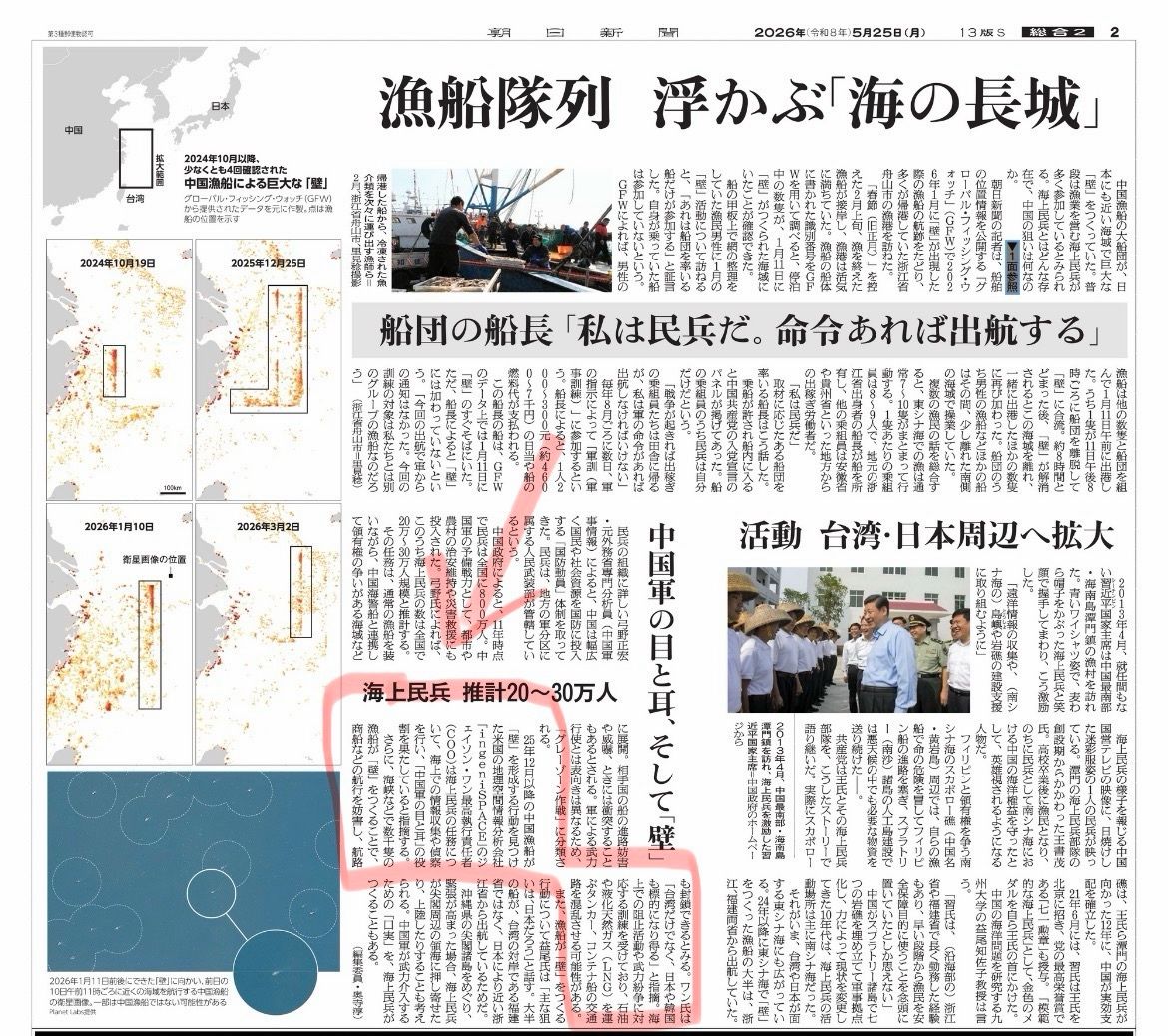
A Chinese fisherman recently told reporters from Asahi Shimbun what open-source ship-tracking data has long suggested: those massive lines of boats forming repeatedly across the East China Sea (ECS) aren’t mere fishing fleets at work -- they’re maritime militia mobilizing for wargames on command.
These are not, however, the same kind of full-time militia forces familiar for their harassment of Vietnamese and Filipino ships in the South China Sea (SCS), but working fishermen who become state-directed paramilitary actors whenever called upon.
Asahi Shimbun's investigation, combined with a recent analysis by Professor Aki Sakabe-Mori in Japan Forward, help to validate the picture of a very different kind of maritime militia than the more organized versions we see to the south around the Paracel and Spratly Archipelagos or Scarborough Shoal.
The People's Armed Forces Maritime Militia (PAFMM)
Article 22 of the China's National Defense Law lists the PAFMM as a separate component alongside the People’s Liberation Army’s active and reserve forces and the People’s Armed Police. Ordinary fishermen can be enrolled in it even as they pursue civilian livelihoods, and may be mobilized as needed to support the military and the coast guard, all while undergoing political education in between.
That's precisely the profile the interviewed captain describes -- one quite different from the Qiong Sansha Yu professional cadre that aggressively interdicts neighboring SCS vessels, or the Spratly Backbone Fishing Vessels that "raft" together silently for weeks at features like Whitsun Reef and Sabina Shoal while collecting subsidies and barely fishing at all.
Instead, these ECS boats are genuine commercial fishing vessels, organized by provincial authorities and mobilized at intervals for wartime rehearsals. Most come from Zhejiang Province, where pilot militia programs began around 2013 with units in cities such as Ningbo, Wenzhou and Taizhou. These are essentially ready reservists, which makes the force both larger and even harder to attribute than their SCS cousins.
Recent Revelations
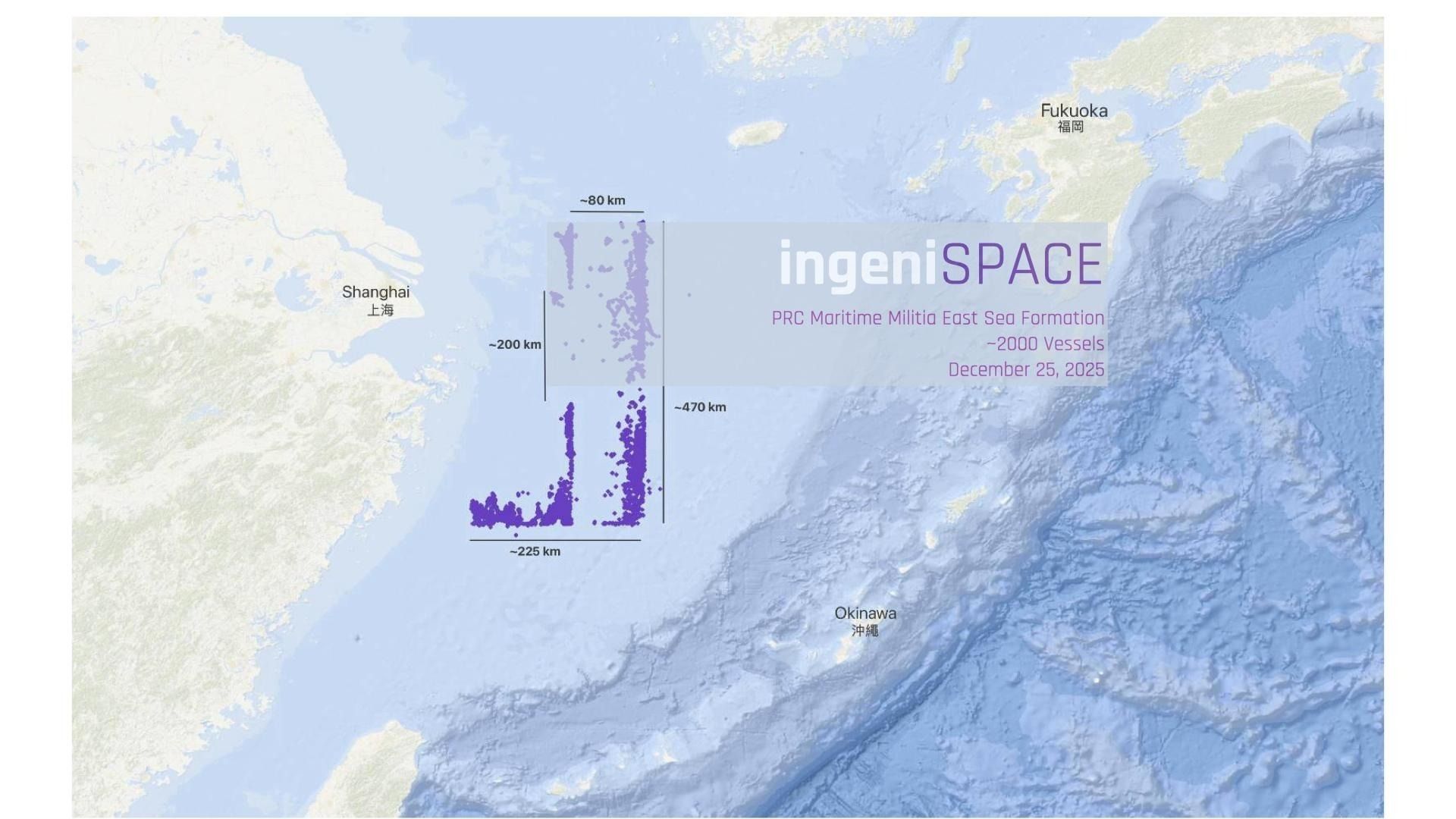
Jason Wang's team at ingeniSPACE were the first to flag the formations in Starboard Maritime Intelligence's tracking data, leading the New York Times to then give them international attention.
Last Christmas ingeniSPACE tracked roughly 2,000 vessels forming a massive inverted-L barrier stretching some 470 kilometers, and then similar such events in subsequent months. On April 3, the Wall Street Journal recorded more than 600 boats holding a straight line for at least 18 hours.
“Their intention is to use these dual-use vessels as irregular warfare to control the waters." -- Jason Wang, quoted in the Wall Street Journal, 15 May 2026
The strategic logic is straightforward: a mobilizable fishing fleet lets Beijing contest the East China Sea without committing its navy, securing its rear as its military forces push into the Pacific. But Sakabe-Mori further identifies three dangers from Japan's perspective (though clearly applicable to China's other potential adversaries).
First, large fleets complicate the Japan Coast Guard's patrols around the Senkaku Islands, as demonstrated in 2016 when 200-300 fishing vessels massed near the islands, and were trailed by coast guard intrusions. They also engineer an asymmetric narrative of "fishermen versus warships" that lets Beijing cast Japanese enforcement as aggression against civilians, even while these vessels clearly act under military direction. Finally, Sakabe-Mori warns that militia units could field unmanned systems for reconnaissance, cable sabotage or electronic warfare in a crisis.
These are civilian vessels used in irregular warfare, designed to minimize the PLA's military signature and shrink the time an adversary has to react. The aim is to confuse the public and exploit bureaucratic seams while signaling to those in the know that China intends to win by overwhelming them. It's worked for a decade in the SCS. The Strait of Hormuz has confirmed Beijing's belief that it's far harder and costlier to get governments to cooperate on protecting commercial traffic than to disrupt it. -- Jason Wang, direct message, 30 May 2026
This fisherman-militiaman is the purest expression of China’s gray-zone strategy, because its structured ambiguity frustrates our neat binary categories -- civil vs. military, legal vs. illegal, peace vs. war -- and lets China's vast and growing paramilitary exploit the gaps we continue to leave unaddressed.