
Ghosts at Anchor

Ray Powell
Share


The Malaysia Maritime Enforcement Agency (MMEA) said in May that the area off its east coast – the Eastern Outer Ports Limits (EOPL) anchorage – is simply too hard to manage, and that the scores of tankers widely suspected of transferring sanctioned oil there are exploiting “jurisdictional gaps” in “remote areas beyond radar coverage”. This key node along the Iran-to-China illicit oil trade cannot be policed, they claim. The waters are just too distant, the ships are just too many, and the transfers are just too quick to be interdicted.
It’s certainly true that the EOPL presents a unique enforcement problem. Because the anchorage is in Malaysia’s EEZ Malaysia cannot board every anchored tanker at will. It generally needs a specific legal basis, such as pollution, unauthorized cargo activity, or another recognized enforcement ground. Were it closer to the coast, within the country’s 12-nautical-mile territorial sea, that would give Malaysia a much freer hand under international law.
But there is a way for MMEA to take effective action against at least some of the bad actors parked offshore. They don’t have to necessarily catch them in the act of conducting illicit oil transfers. They just need to do a little research into who’s broadcasting fake identities, and what that means for their legal protections.
There are a lot of these ships carrying around fake IDs, and the EOPL is one of their favorite hangouts. SeaLight – together with substantial help from our friends at Starboard Maritime Intelligence – has identified at least seventeen anchored there as of the start of July 2026.
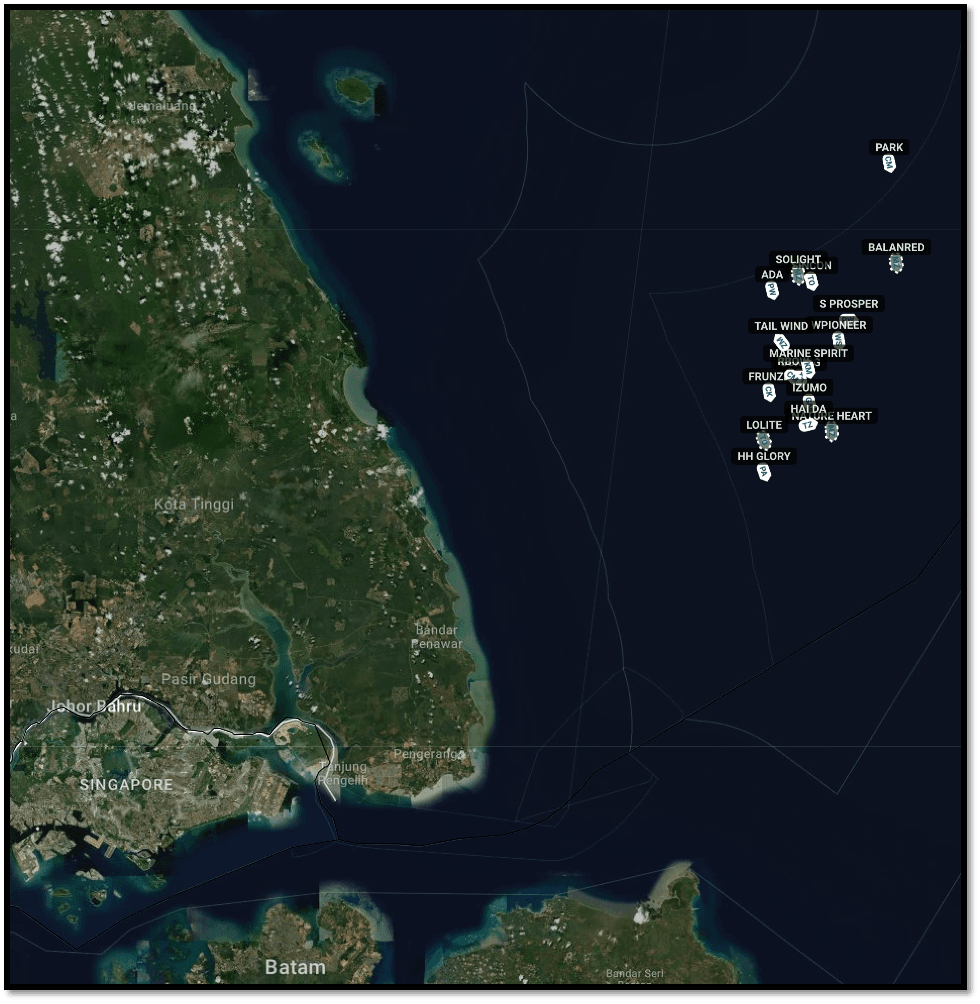
Eleven of these ships are “zombies”, or ships that are broadcasting the International Maritime Organization (IMO) registration numbers of other vessels that were retired and cut up for scrap years ago. This is the equivalent of stealing the identity of a person who has died.
The other six are on a separate list of IMO-confirmed “false flags”, or ships the agency has researched and formally confirmed are broadcasting registration information that the claimed countries’ registrars never issued.
These tactics are common to shadow-fleet vessels, but it also leaves them uniquely vulnerable, because a ship that claims a flag no government will vouch for effectively belongs to no one. It is considered a stateless ship, and thus loses the protections that would otherwise let it sit at anchor unmolested in a place like the EOPL.
What is the Eastern Outer Ports Limits anchorage?
The EOPL anchorage sits roughly 45 nautical miles (about 70 km) off the Malaysian province of Johor, conveniently located just northeast of the Singapore Strait. It is a long-established and heavily used waiting area, where at any given time scores of merchant ships sit at anchor waiting for orders, berths or bunkers.
Among this gathering sit our seventeen “fake ID” ships, with their registered identities verified via Equasis:
| Broadcast name | Broadcast IMO number | Broadcast flag | Registered identity (per IMO) | Type |
| ADA | 9108154 | Palau | Ada, a tanker scrapped in 2018 | Zombie |
| BALANRED | 9233313 | Mozambique | Oceania, a tanker scrapped in 2021 | Zombie |
| FRUNZE | 9263643 | Cook Islands | Real hull; register marks the flag FALSE | False flag |
| HAI DA | 9033787 | Tanzania | Real hull registered as Yu Shun; register marks the flag FALSE | False flag |
| HH GLORY | 9534614 | Panama | Real hull; register marks the flag FALSE | False flag |
| IZUMO | 9249324 | Gabon | Real hull; register marks the flag FALSE | False flag |
| LOLITE | 9337195 | Tonga | Real hull; register marks the flag FALSE | False flag |
| MARINE SPIRIT | 9288019 | Comoros | Real hull (ex-Peace Hill); register marks the flag FALSE | False flag |
| NATURE HEART | 9251585 | Mozambique | Nabiin, a tanker scrapped in 2021 | Zombie |
| PARK | 9177167 | Cameroon | Eros, a supertanker scrapped in 2018 | Zombie |
| RBOW | 9208045 | Cameroon | Nordic Spirit, a tanker scrapped in 2019 | Zombie |
| S PROSPER | 9181936 | Palau | S Prosper, a tanker scrapped in 2018 | Zombie |
| SCIONG | 9259173 | Tonga | Aframax River, a tanker scrapped in 2021 | Zombie |
| SINCON | 9212864 | Tonga | EM Longevity, a tanker scrapped in 2021 | Zombie |
| SOLIGHT | 9252979 | Mozambique | North, a tanker scrapped in 2022 | Zombie |
| TAIL WIND | 9184603 | Zambia | Pacific Silver, a tanker scrapped in 2018 | Zombie |
| WPIONEER | 9202716 | Samoa | S Millennium, a tanker scrapped in 2018 | Zombie |
Why these ships are vulnerable
Every ship traveling in international waters is supposed to carry two things that identify what it is: a permanent seven-digit IMO number, which stays with a hull for its entire life, much like a vehicle identification number, and a national flag, which is the country that has registered the ship and is legally responsible for it. Both types listed above are lying about who they are – the only difference is how we know they’re lying.
The zombies were caught by Starboard Maritime Intelligence analysts by investigating their broadcast IMO numbers, where they learned that they’ve effectively stolen the ID of a “dead” ship. SeaLight has confirmed this information by cross-checking it directly in Equasis.
The "false-flag" ships, meanwhile, have been so designated in the world's official IMO ship records, after an investigation in which the claimed flag’s government confirms the ship was never on its register. In other words, these are the ships whose fraud the IMO has individually and officially confirmed.
Fake flags and statelessness
A ship’s claimed nationality is not decorative. It is what gives the vessel the legal right to be on the water. Under international law, a country may only put a ship on its register if there is a real connection between the two: the country actually enters the vessel in its books and takes responsibility for inspecting and controlling it. The legal authority everyone works from, the UN Convention on the Law of the Sea (UNCLOS), calls this the “genuine link”.
Some countries are well known to carry out their inspection-and-control responsibilities poorly, making them the favorites of less reputable or outright illicit shipping companies. We often refer to these as “flags of convenience”.
The seventeen ships listed above, however, take this a step further, in that they are claiming a flag identity that the named country never issued, so that the “genuine link” simply does not exist. Such a vessel without a valid nationality is treated, under UNCLOS, as having none at all. It is considered stateless.
Statelessness is the core problem with these ships, but also their core vulnerability to MMEA intervention. A properly flagged ship enjoys broad freedom to navigate within an EEZ and to do all the ordinary things ships do on the high seas, including waiting at anchor. A nation-state’s EEZ rights are mostly about resource exploitation, not policing who parks where. A normal ship at anchor with its transponder on is hard to touch without its flag-state’s authorization.
A stateless ship is different in that it has thrown away the nationality that such protection depends upon. A vessel broadcasting the identity of a ship scrapped in 2018 and under a flag no one will confirm is a ship with no country, and it is advertising that fact on every signal it broadcasts.
That’s why the fake identity, not the anchoring, is its most exploitable vulnerability. The point isn't that Malaysia must prove statelessness in advance, it's that broadcasts this blatantly fraudulent creates the reasonable suspicion Article 110 requires, and a boarding itself should resolve the question.
What Malaysia can actually do
This is where a little research can help Kuala Lumpur make a real dent in the EOPL shadow tanker fleet.
The law gives Malaysia at least three levers to pull against these ships; the one it keeps pointing at is the weakest, while the fake identity lever is the strongest. Enforcement gets easier the further you move from where the ship is sitting to what the ship claims to be.
Lever One – policing the anchorage (weakest): For a ship just sitting in the EOPL with its transponder active, no cargo work and emitting no pollution, MMEA has few practical options. That is the essence of the “maritime loophole” it has complained about. Although Malaysia withdrew the area’s formal designation as an international anchorage last year, this in itself doesn’t strip a ship of its freedom of navigation rights under UNCLOS.
Lever One – policing the anchorage (weakest): For a ship just sitting in the EOPL with its transponder active, no cargo work and emitting no pollution, MMEA has few practical options. That is the essence of the “maritime loophole” it has complained about. Although Malaysia withdrew the area’s formal designation as an international anchorage last year, this in itself doesn’t strip a ship of its freedom of navigation rights under UNCLOS.
Lever Two – catching them in the act (stronger): The moment a ship does something – transfers cargo, spills oil, etc. – MMEA’s options expand. International law lets a coastal state inspect and, in serious cases, detain a vessel in its EEZ for pollution or unlawful transfers, and Malaysia's recent crackdown on unauthorized ship-to-ship transfers adds teeth: cargo transfers now need written government permission, refueling at anchor is banned and officers may detain any vessel that causes or threatens pollution, with fines reaching RM1 million under the EEZ Act and release only against security for the damage.
This is not hypothetical: seven of the seventeen tankers above logged a visible ship-to-ship transfer signature in June, and each of these is a potential opening. The issue is whether MMEA can actually catch them doing it, and early returns have not been promising.
Lever Three – fake IDs (strongest): No cargo transfer needed. Just compare what the ship claims to what the record shows.
Under UNCLOS, nationality is what gives a ship the right to be on the water. Article 91 requires a “genuine link” between a state and its registered ships, while Article 92 makes the flag exclusive and treats a vessel misusing flags as one “without nationality”. A ship broadcasting a registration its claimed state never issued has no such link.
That statelessness strips its legal protections. Article 110’s “right of visit” lets a government vessel board a ship on reasonable suspicion that it is “without nationality”, and a hull broadcasting the registration of a ship scrapped in 2018 supplies exactly that ground. Meanwhile, Malaysia’s own Act 633 already lets MMEA board, search and detain across its entire maritime zone.
UNCLOS can justify the visit; Malaysian law controls what officers may do next.
Why it matters
The EOPL cluster is not merely a parking lot for idle ships, but also a critical hub in a massive operation that illegally moves oil from Iran to China’s teapot refineries aboard tankers wearing fake identities; a deception built to keep cargo and ownership hidden from whoever is watching. The June 2026 US–Iran ceasefire and temporary 60-day license don’t solve the problem: the relief is narrow and temporary, and it is American only. Sanctions by the UK and EU remain in force. Moreover, these ships are built not around any single sanctions list but to be hard to trace.
Starboard tracking showed a total of 55 of these fake-identity tankers visibly operating worldwide as of 1 July, while others are almost certainly operating “dark”. Almost all of them worked along the Iran-to-China route, and the EOPL is their well-documented mid-ocean transfer point, where illicit oil is “laundered” to obscure its origins. The fact that over 30 percent of these vessels are anchored in the EOPL on a single day drives that point starkly home.
The bottom line
Malaysia says this anchorage is too hard to police, and in one sense it is right: these ships have learned that sitting far enough offshore with transponders on largely keeps them safe from inspection where the odds are in their favor. But the fake-ID ships are handing MMEA something far easier to act on. The disguise that keeps the oil moving is also the thing that strips them of their legal cover, and it is the one part of the operation that is written into every signal they broadcast.
That is the low-hanging fruit: is this ship what it claims to be? If not, it has given up its protections and left itself open to boarding, inspection and detention. This is action Malaysia could take today.