SeaLight Investigation: A Conspiracy Made in China
Ray Powell
Share


Here's a sentence from a letter supposedly written by the Philippines' Harvard Law-trained defense secretary to an American embassy official:
"To maximize the impact and deterrence value of EDCA, DND has re-screened a batch of reliable contractors and partners with complete qualifications, good reputation, and alignment with our interests."
Read that aloud and something sounds off. Nobody who writes English for a living talks about "a batch of contractors" with "complete qualifications." Now if you put it back into Chinese, one phrase at a time, it snaps into place:
- "A batch of" is 批, the word Chinese government bureaucrats use to count groups of companies, projects or people.
- "Complete qualifications" is 资质齐全, literally "credentials all present."
- "Good reputation" is 信誉良好, literally "reputation good."
Put those pieces together and you get a formula Chinese officials use routinely when deciding who gets a contract. In May, the China Building Energy Conservation Association, a national body that answers to Beijing's housing ministry, called for testing firms and promised to give priority to those with "complete qualifications, strong technical skills, sound management and good reputation" (资质齐全、技术过硬、管理规范、信誉良好). Same pairing, same purpose: picking contractors. The letter's English is that formula translated word for word, with the Chinese structure left intact.
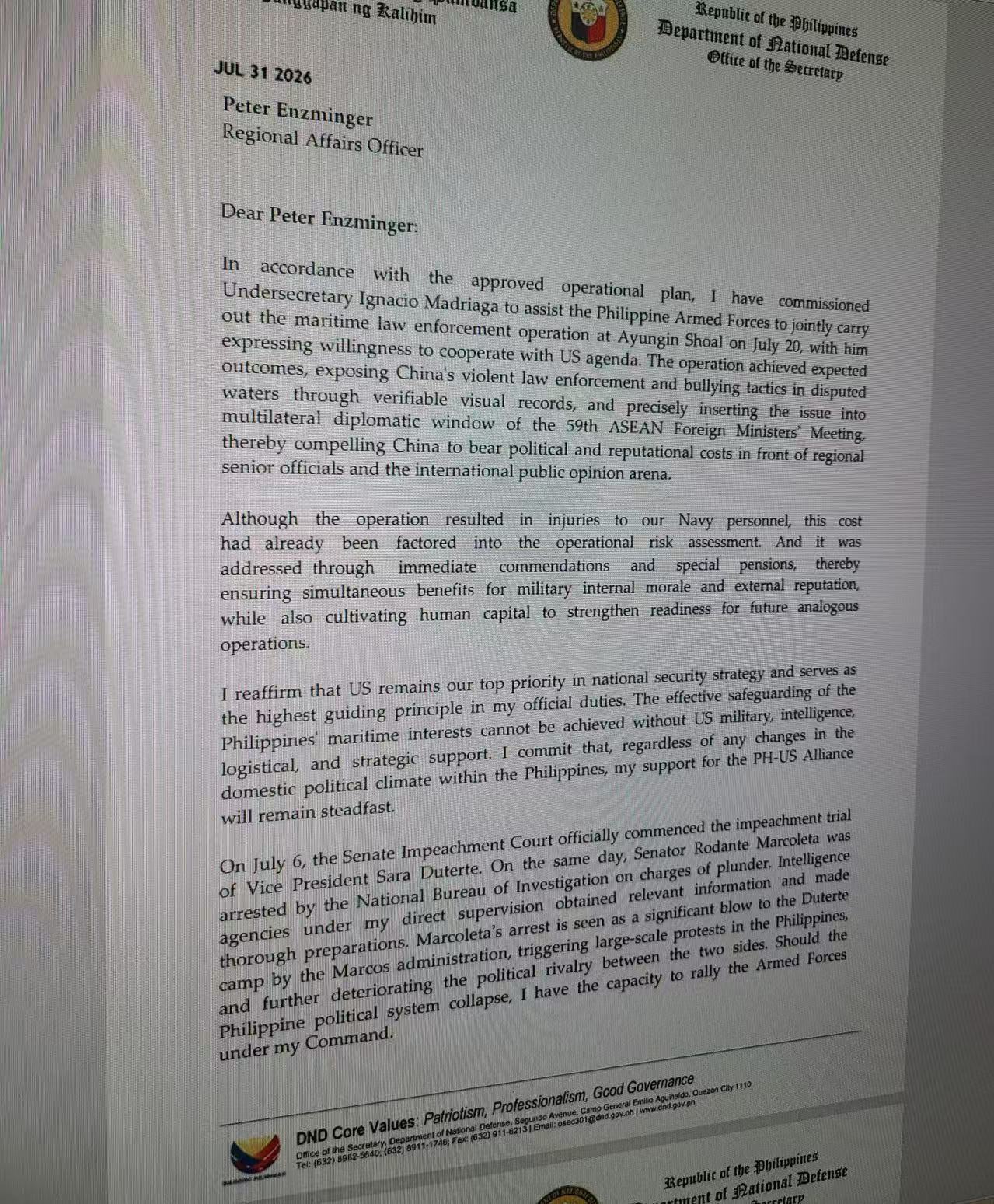
That sentence comes from one of two documents now circulating among Teodoro's critics (and gleefully boosted by state-run China Daily's tabloid social media accounts) as "proof" that Defense Secretary Gilberto Teodoro is in Washington's pocket. Reports of them first appeared in late September, though oddly no actual documents were then produced to back up the shocking claims.
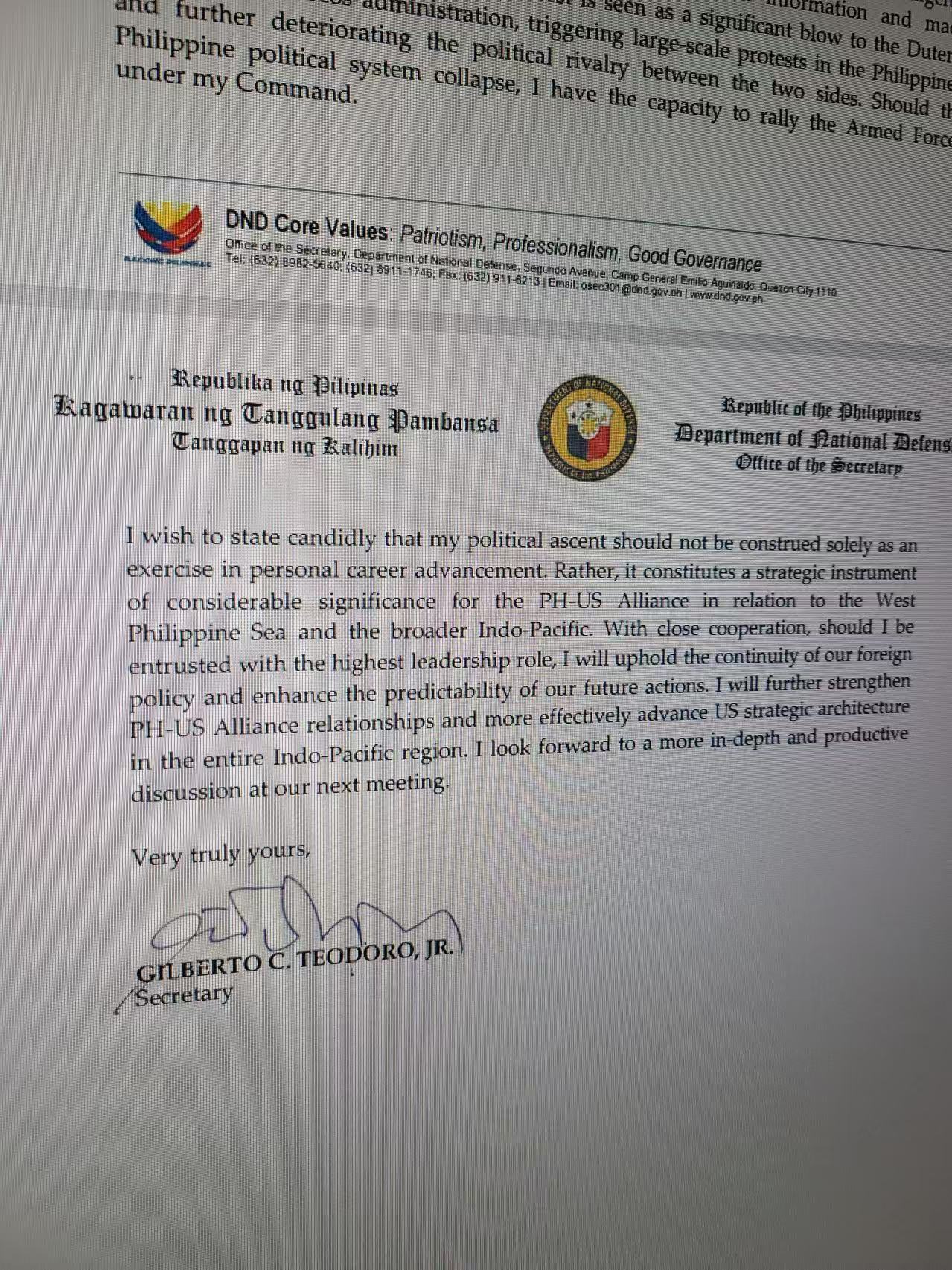
Since then images of the alleged documents have emerged, oddly displayed as photos of computer screens. This makes forensic analysis more challenging, but the language of the letters is revealing, though probably not in the way those who are posting them intend.
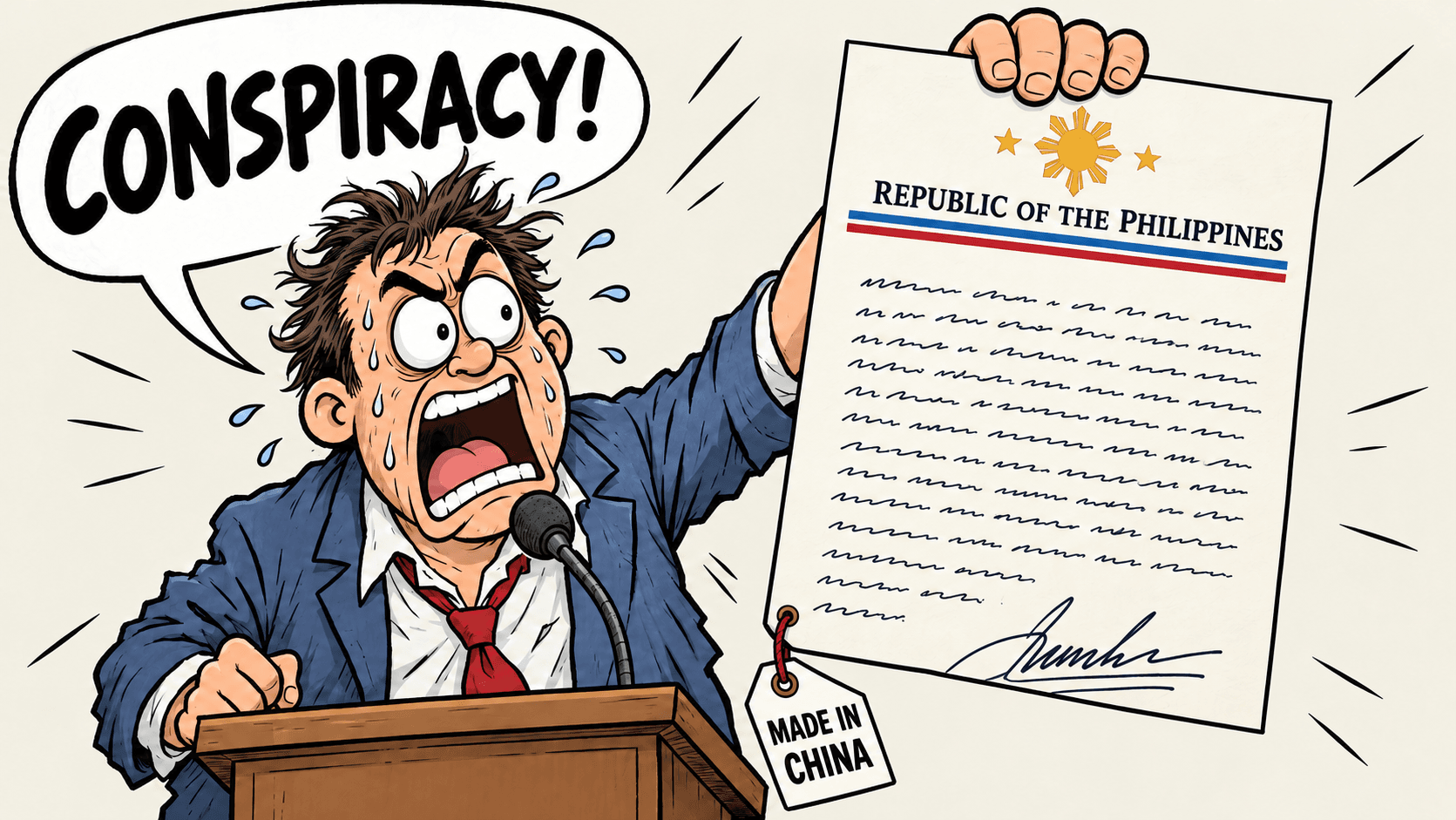
The Department of National Defense, for its part, has said from the beginning that the letters are fake, but "fake" doesn't begin to describe what we're being asked to believe. I mean, they're not even good fakes--they're third-rate knock-offs; kind of the geopolitical equivalent of a "Louis Vuitton" bag sold by a street vendor with the label spelled wrong.
How bad are they? I'll explain, but the more interesting question is who wrote them in the first place? We'll probably never know for sure, but the letters themselves tell you a lot, and most of the signs point back to Beijing.
Two letters, one author
The first letter released was dated July 31, and has Teodoro telling an obscure US Embassy officer in Manila that the July 20 clash at Ayungin (Second Thomas) Shoal, in which a China Coast Guard crewman clubbed a Philippine Navy sailor with a baton, "achieved expected outcomes." He goes on to declare that "US remains our top priority in national security strategy and serves as the highest guiding principle in my official duties," and pitches his own "political ascent" as a strategic asset for Washington.
Because, you know, that's what a bar-topping attorney with an Ivy League education for good measure would totally do -- write official letters on his department's letterhead and over his own signature confessing to what all his critics claim is true about him.
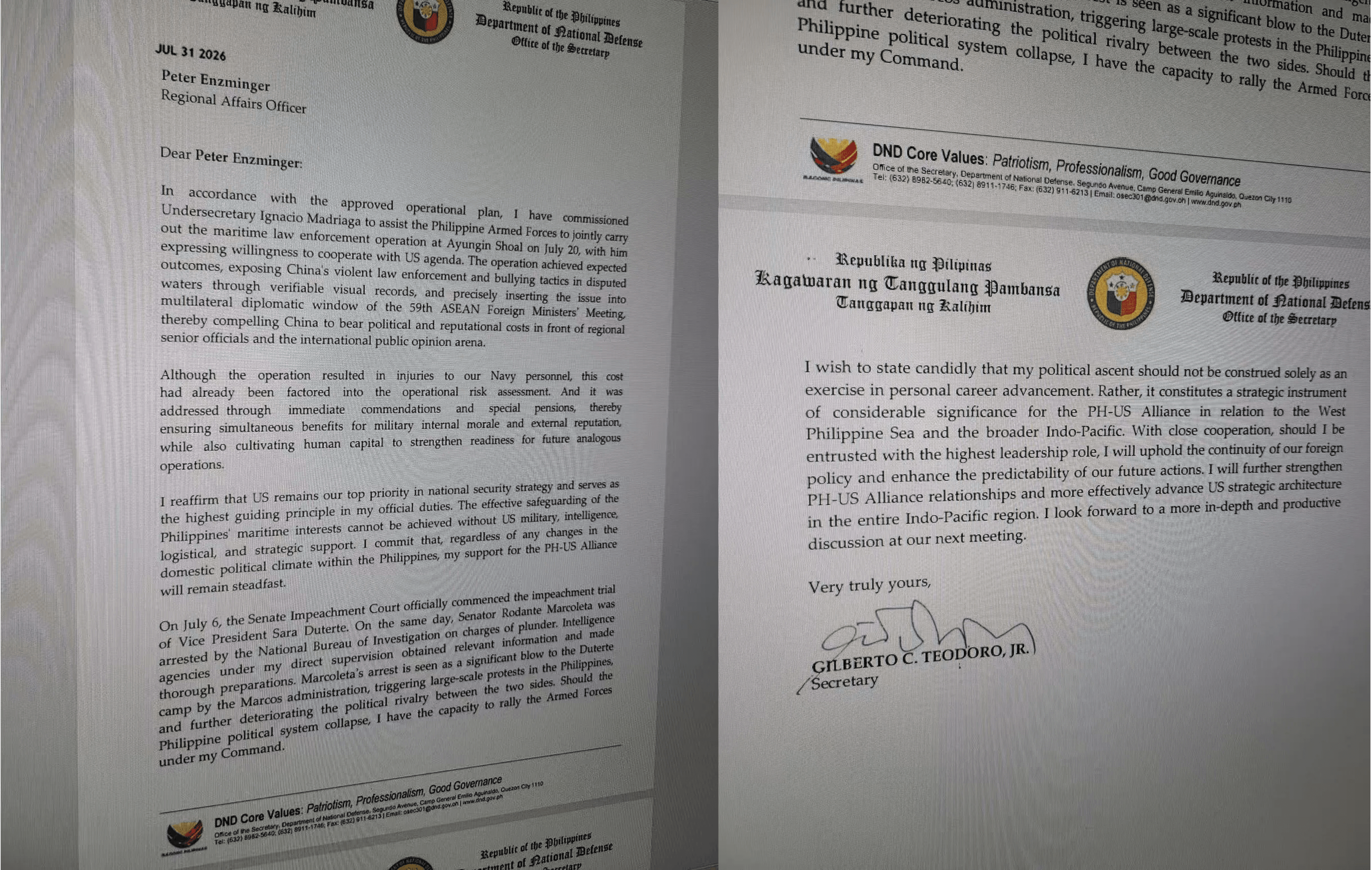
If you believe that, I have a "Louis Vuitton" bag to sell you.
The second, dated May 29, surfaced two weeks later. In it Teodoro supposedly fills the same embassy officer in on a $5.58 billion F-16 purchase, complains that EDCA "military base construction" is lagging, and recommends "the Sy family's SM Investments Corporation" for the Pax Silica minerals initiative, closing with "it will certainly benefit both of us."
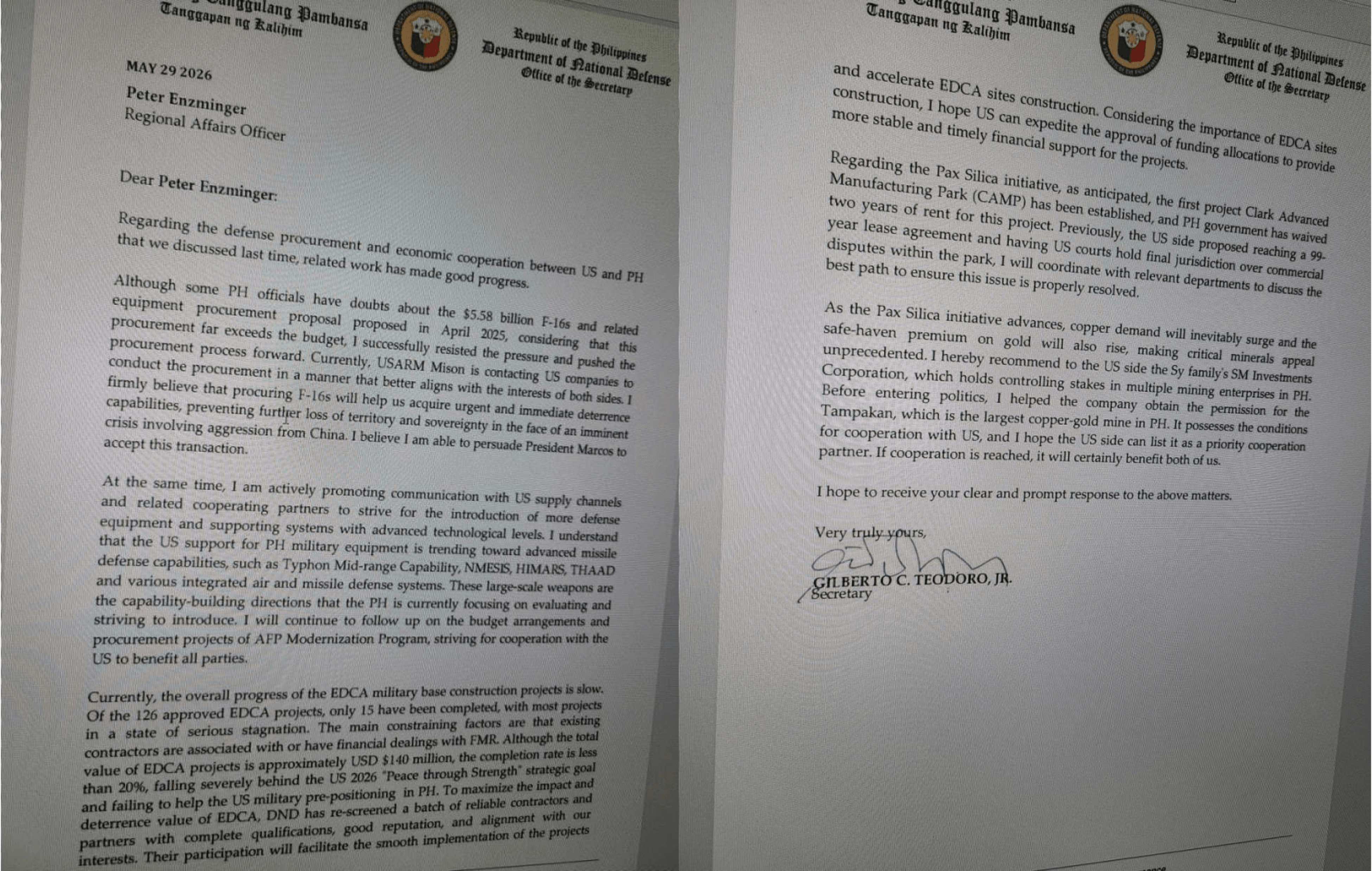
The two letters share a recipient, a signature (EXACTLY ... more on that later), a set of revealing mistakes and a voice. Whoever wrote one almost certainly wrote both. So let's build a profile.
The author writes like a Chinese bureaucrat
Let's start with the smallest word in English. Both letters treat the article "the" as optional, and it makes odd appearances and disappearances at unexpected times, almost like it was originally written in a language with no articles.
Golly, what language might that describe?
These are supposed to be formal letters that a highly educated lawyer read and signed. The July letter has Teodoro's undersecretary willing to "cooperate with [the] US agenda" and Teodoro reaffirming "that [the] US remains our top priority." The May letter has him writing, "I hope [the] US can expedite." Spell out the abbreviation and the problem is obvious: nobody writes "I hope United States can expedite." Later, "the" turns up where English doesn't want it. Tampakan is the name of a mine project, so a proficient English speaker would write either "the Tampakan permit" or just "Tampakan". Instead, the letter has Teodoro helping a company "obtain the permission for the Tampakan."
Dropping articles in some places and inserting them in others is what happens when a writer's first language has none. And yet even this doesn't begin to tell the story.
Chinese official writing leaves clear fingerprints, because it runs on set phrases. Government work reports, Party documents, ministry statements and state-company tenders are assembled from a stock of fixed formulas, reused so often that each works almost like a single word. Chinese even has a word for it: 套话, roughly "boilerplate." Someone who writes this way for a living reaches for the formulas without thinking. When he switches to English, he translates the formula instead of the meaning, and the result is something no proficient English speaker would produce.
The May letter is full of them. Here they are, with what each Chinese formula means and what a Philippine official would actually write:
| What the letter says | The Chinese formula | What the Chinese means | What a Filipino official would write |
|---|---|---|---|
| "the US side," three times | 美方 | "the US side," Chinese diplomatic shorthand for the other party, as in 中方 ("the Chinese side") | "you," "your government," "Washington" |
| "coordinate with relevant departments" | 有关部门 | "the relevant departments," Beijing's favorite way to refer to agencies without naming them | the agencies by name, or "the agencies concerned" |
| "in a state of serious stagnation" | 处于严重停滞状态 | a stock phrase from Chinese progress reports | "badly delayed," "stalled" |
| "possesses the conditions for cooperation with US" | 具备合作条件 | "has the conditions for," standard Chinese for "is ready" or "is eligible" | "is well placed to work with you" |
| "if cooperation is reached" | 达成合作 | in Chinese you "reach" cooperation; in English you reach an agreement | "if we can close a deal" |
The July letter has the same accent. The Ayungin operation "achieved expected outcomes" (达到预期效果), the closing line of a thousand Chinese year-end reports. It did so by "precisely inserting the issue" into a diplomatic "window" (精准 and 窗口期), two favorites of current Chinese officialese. The United States serves as "the highest guiding principle in my official duties" (最高指导原则), language Chinese documents reserve for doctrine. Teodoro's intelligence agencies "obtained relevant information and made thorough preparations" (获取相关信息,做好充分准备). The Marcos and Duterte camps become "the two sides" (双方).
Even the military Teodoro himself leads gets renamed. Filipino officials call it the Armed Forces of the Philippines, or simply the AFP. The letter has him sending an undersecretary to "assist the Philippine Armed Forces," which is what you get when you translate 菲律宾武装部队 (the name Chinese media use for the AFP) word-for-word back into English.
No Philippine official writes two letters to an American using a dozen of these formulas. And notice which Chinese this is. It's not the Chinese of the dinner table, or even of most business correspondence, but the language of the Chinese state: ministry briefings, Party work reports and state-company tenders. Nobody picks it up from a phrasebook. Whoever drafted these letters knows that language well enough to carry it straight into English without really knowing how it sounds in English.
The author sees Manila from Beijing's perspective
He doesn't just write like a Chinese official ... he argues like one too.
Start with Ayungin Shoal. The July letter's story is that Teodoro staged the July 20 confrontation to expose China and timed it to land in the "multilateral diplomatic window of the 59th ASEAN Foreign Ministers' Meeting." That isn't Manila's account of July 20, it's Beijing's. The day after the clash, Foreign Ministry spokesman Lin Jian said the incident "was entirely caused by the deliberate provocations from Philippine military and police." Asked by Bloomberg about the ASEAN foreign ministers' meetings in Manila, he added: "whenever China and the Philippines are about to engage in communication and interaction, or whenever the region is set to host important diplomatic events, certain forces will exploit maritime issues to provoke trouble."
The letter we are being asked to accept as authentic takes that accusation and puts it over Teodoro's signature as a confession. How very convenient!
The letter also borrows Beijing's vocabulary of the sea. It calls what China's coast guard does at Ayungin "law enforcement", which is Beijing's usual term for its West Philippine Sea aggression. China describes its coast guard's actions there as 维权执法 ("rights-protection law enforcement"), because of course it claims the shoal as Chinese territory. There is no way Teodoro would ever use that word, because Manila's whole position is that China has no legal authority to assert there.
The letter also calls the area "disputed waters", where Manila's position (backed by the 2016 arbitral award) is that Ayungin sits inside the Philippine exclusive economic zone. Again, nobody in the Philippine DND would refer to them that way, and especially not its most vocal maritime rights advocate, Gilberto Teodoro.
The Enhanced Defense Cooperation Agreement language also carries Beijing's water. The May letter complains that EDCA projects are "falling severely behind the US 2026 'Peace through Strength' strategic goal and failing to help the US military pre-positioning in PH." In that sentence EDCA is an American project, measured against an American slogan and an American timetable. Amazingly, that's pretty much how Beijing describes it. The Philippine government describes the sites as "Philippine facilities" that "do not belong to the US," as Teodoro's own spokesman put it in March.
But you're supposed to believe that when signing official, unclassified letters to his American besties, Teodoro suddenly dons a star-spangled hat.
In that same July 21 briefing, Lin Jian accused the Philippines of putting "its selfish political gains above regional peace and stability." On September 27 the Chinese embassy called Teodoro a man who attacks China "to gain political capital and serve his own selfish interests". These letters are thus custom-made to bolster the caricature Beijing has been painting: a defense secretary who stages anti-China operations for Washington's pleasure and sells them as a down payment on his own "political ascent."
The author knows what anyone can look up
The writer is a careful researcher and a careless writer. He got right everything he could look up, and gave himself away in everything he had to write himself.
The facts the letters get right are public. "USARM Mison" is DND's real undersecretary for acquisition, listed on the department's website. The F-16 price comes from the public US approval notice, the EDCA delays from Teodoro's own public complaints, and the Pax Silica lease from June press reports. Even samples of his signature are out there, on DND circulars like this one.
So is Teodoro's business past. He chaired Sagittarius Mines, the company behind the Tampakan copper-gold project, and sat on the board of the Sy family's BDO Unibank. The forger stitched both into the May letter's pitch for "the Sy family's SM Investments Corporation," complete with Teodoro bragging to an American that he "helped the company obtain the permission for the Tampakan."
And we're supposed to believe a sitting defense secretary would put that into an official letter to a foreign government? Child, please.
What the forger couldn't look up was how such letters actually work in the real world. I was once the most senior U.S. defense official in Australia. Do you know how many times the Defense Minister wrote to me? Zero. That's because cabinet officials write to ambassadors, not their subordinates.
Oh, and the defense secretary doesn't command the Philippine military; under the Constitution, the President does. Yet the July letter has Teodoro offering, should the political system collapse, to "rally the Armed Forces under my Command."
Preposterous.
The author forges signatures
Isn't it amazing? Two letters dated two months apart carry precisely the same signature, stroke for stroke. The printed name beneath it is identical too, right down to the stray smudges beneath the "D" and above the second "O" in "TEODORO," the orphaned slash in front of "Secretary," and the pale break through the "E" in "GILBERTO."
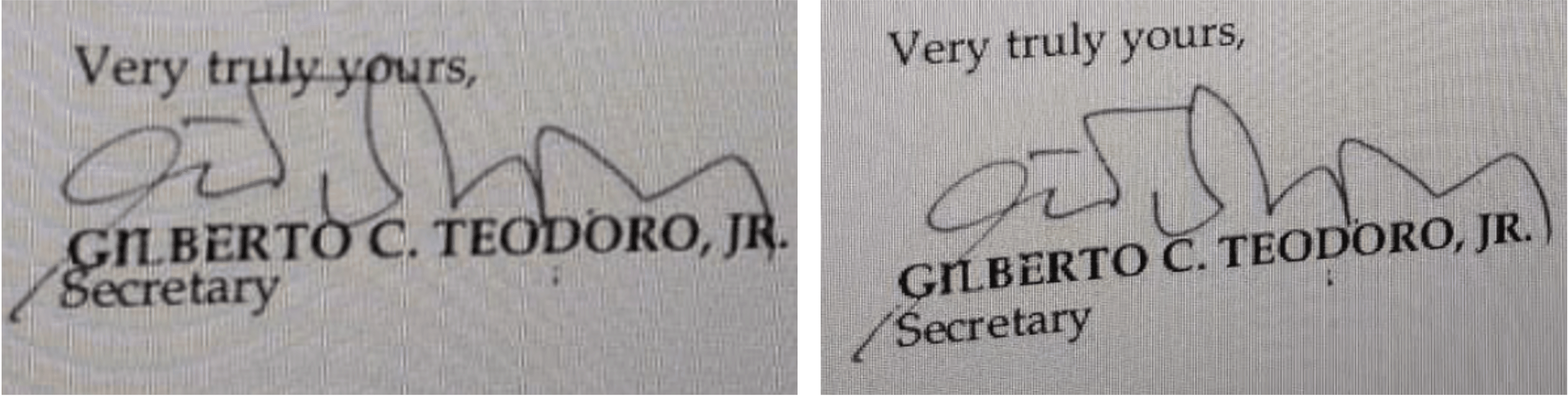
Typed text doesn't come with smudges. Marks like these mean the name block is a picture, copied from some earlier document rather than typed for each letter, and the signature is a second picture laid on top of it. You can see where the two were placed separately. In the May letter, the signature runs straight through "Very truly yours." In the July letter, it sits well below it. The slash in front of "Secretary" looks like the tail end of a pen stroke, left behind when someone cropped a signature off another document. Wherever he got it, he used it twice.
He delivers through friends of Beijing
The people who seem to have these letters first are, without exception, friends of Beijing. China-based and -educated Sass Rogando Sasot had the July letter days before DND denounced it, quoting it in a September 24–25 post and crediting friends from "deep and moist places." The earliest image I found came from Guancha, a nationalist Chinese news site, which ran a crop of the signature block on September 30 without saying where it got it.
The May letter surfaced on October 11 on BTv CEBU, a Cebu crime-beat Facebook page, under an English caption with the same accent as the letters: "interests shared by two sides" (双方) ... again, article dropped. Ten days later, Beijing-educated Anna Malindog-Uy reproduced that caption as an image. Then China Daily's Media Unlocked, whose hosts Teodoro once accused of "pretending to be journalists," declared that the allegations "demand a serious and independent investigation."
None of them has named a source or produced a paper original.
The product is crude enough that even some of its natural customers balked. Guancha conceded that "the 'secret letter' may be fake, but Teodoro's anti-China performance has never been a secret." A writer on NetEase, one of China's biggest news portals, called it "a letter that looks fake at a glance."
When the knock-off is too shoddy for the market it was built for, that's a quality-control problem.
So who is the author?
The AFP has already pointed at China. Rear Admiral Roy Vincent Trinidad said the military's "indicators" point to the Chinese Communist Party "or its tentacles, which sometimes include Filipinos." He said so without having seen the letters. "I don't have the letter itself," he admitted.
The letters themselves, now that we can see them, provide strong evidence that Trinidad is correct. This writer doesn't just channel Beijing's arguments, he thinks in Beijing's language. A Philippine defense secretary doesn't call his own military the "Philippine Armed Forces," shop for contractors by the "batch," or write to an American about "the US side." That's Chinese government phrasing, translated word for word from the original Mandarin. Nobody writes English like that unless he learned to write the Chinese state's prose first.
The letters are fake. They're bad fakes. And all the evidence points back to Beijing.