
Interview: The Defense Secretary Who Won't Back Down From China
Ray Powell
Share


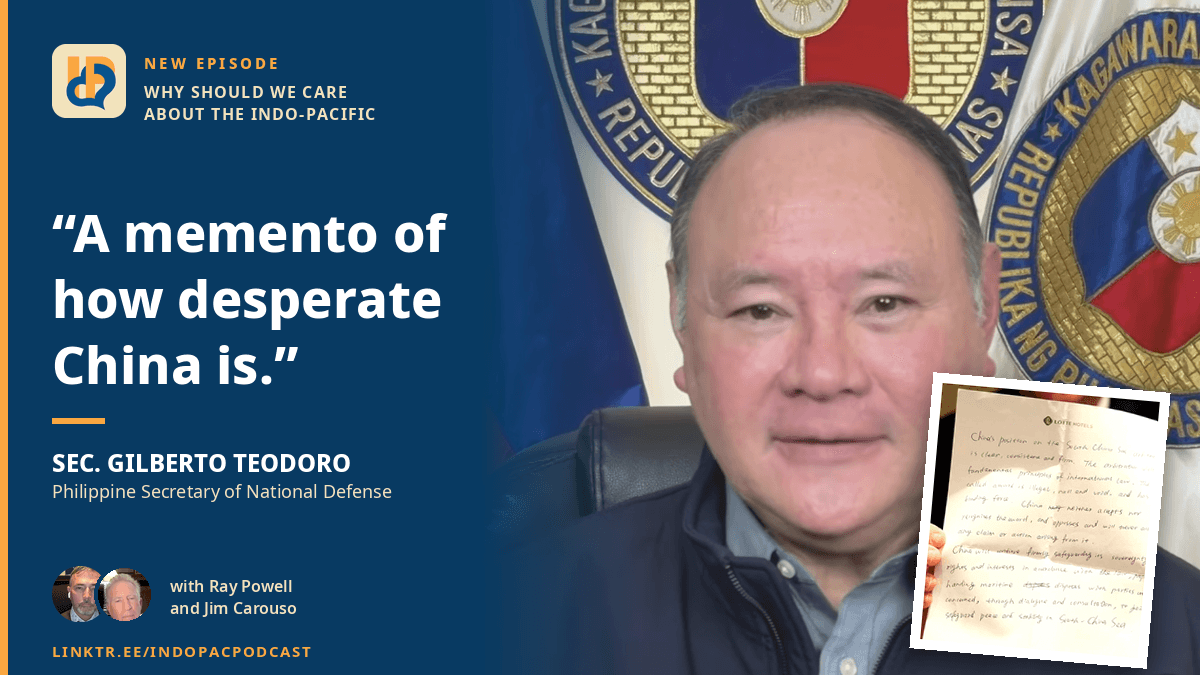
On September 8th at the Seoul Defense Dialogue, Philippine Secretary of National Defense Gilberto Teodoro was on stage taking a question about the South China Sea when a forum staffer walked over and handed him a piece of paper. It was a note, handwritten on hotel stationery, from the Chinese delegation at the conference.
Quickly recovering from his obvious surprise at this unusual intervention, Teodoro decided to read it out loud.
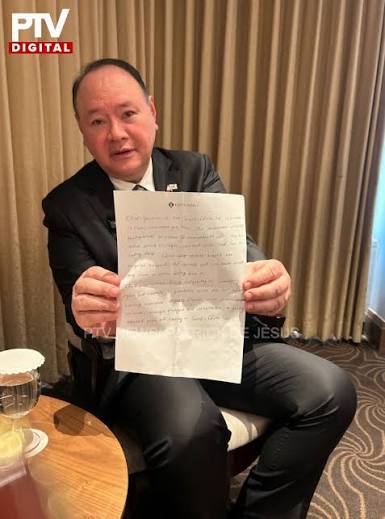
The note was essentially a collection of Beijing's standard talking points, asserting that the 2016 arbitration ruling won by the Philippines -- the landmark ruling which declared China's infamous nine-dash line claim is not supported under the 1982 United Nations Convention on the Law of the Sea -- was itself "illegal, null and void" and was not binding upon China.
"Of course, because you lost," he replied, as he rebutted each point in turn. He said afterward that he would keep the paper as "a memento of how desperate China is."
Last week Jim Carouso and I had the chance to ask him about that extraordinary event for our podcast, Why Should We Care About the Indo-Pacific?. He told us the note was not a one-off. He has now personally experienced the same approach at five regional forums, where PRC participants use the question period to deliver a "lecture" instead. He's also seen people holding press credentials at these conference specifically to ambush Philippine delegations.
He reads this pattern as a broader effort "to make a more Sinocentric world," raising Palau as another country being told it is too small to object.
On the insults he gets from Beijing, Teodoro was blunt. When China's foreign ministry call him and other Filipino officials who push back "a handful of grandstanding buffoons" in Chinese, their own English-language translation of the same remarks softened that to "certain individuals." His read: "It's duplicity, plain and simple. That's what they are. Not as a people, mind you, but as a party."
We also got into why he shut down his department's hotline with Beijing; what a Code of Conduct would have to contain have real benefits for the defense of the Philippines; the illegal steel plants his people have been raiding; why he cannot imagine a Taiwan conflict that doesn't implicate vital Philippine interests; and what the war in Ukraine taught him about resilience, reserves and allies.
"Peace", he said, "is not a free dividend. It is purchased, it is bought, and it is enforced."
It was an extraordinary interview. Watch the whole thing!