
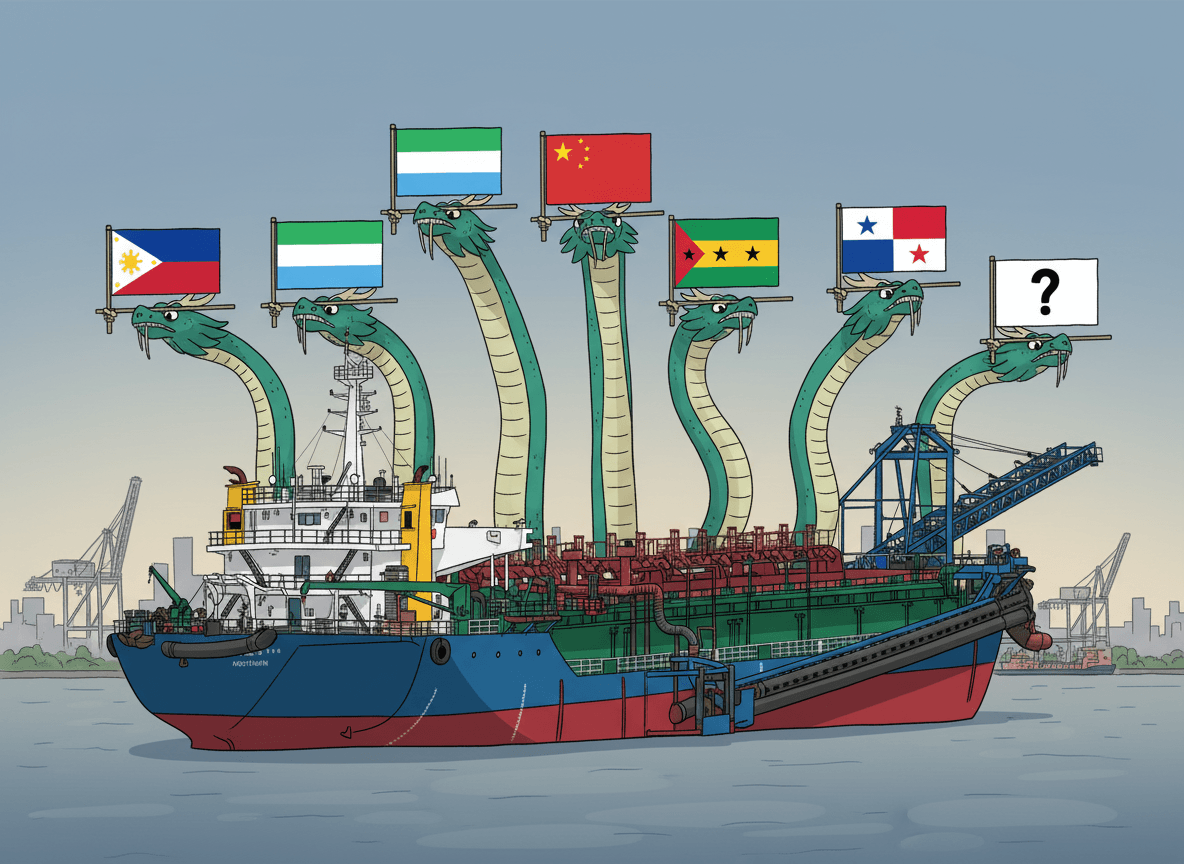
The Hydra of Manila Bay
Ray Powell
Share


At 9:00 pm last Friday evening, two ships with identical names slipped their moorings in Manila Bay en route up to the Santo Tomas River mouth in Zambales Province. Except that's not true. The Sierra Leone-flagged Kang Ling 539 and the Philippine-flagged Kang Ling 539 are not two ships, but one--a single dredger that has broadcast at least 30 identities since first arriving in the Philippines over two years ago.
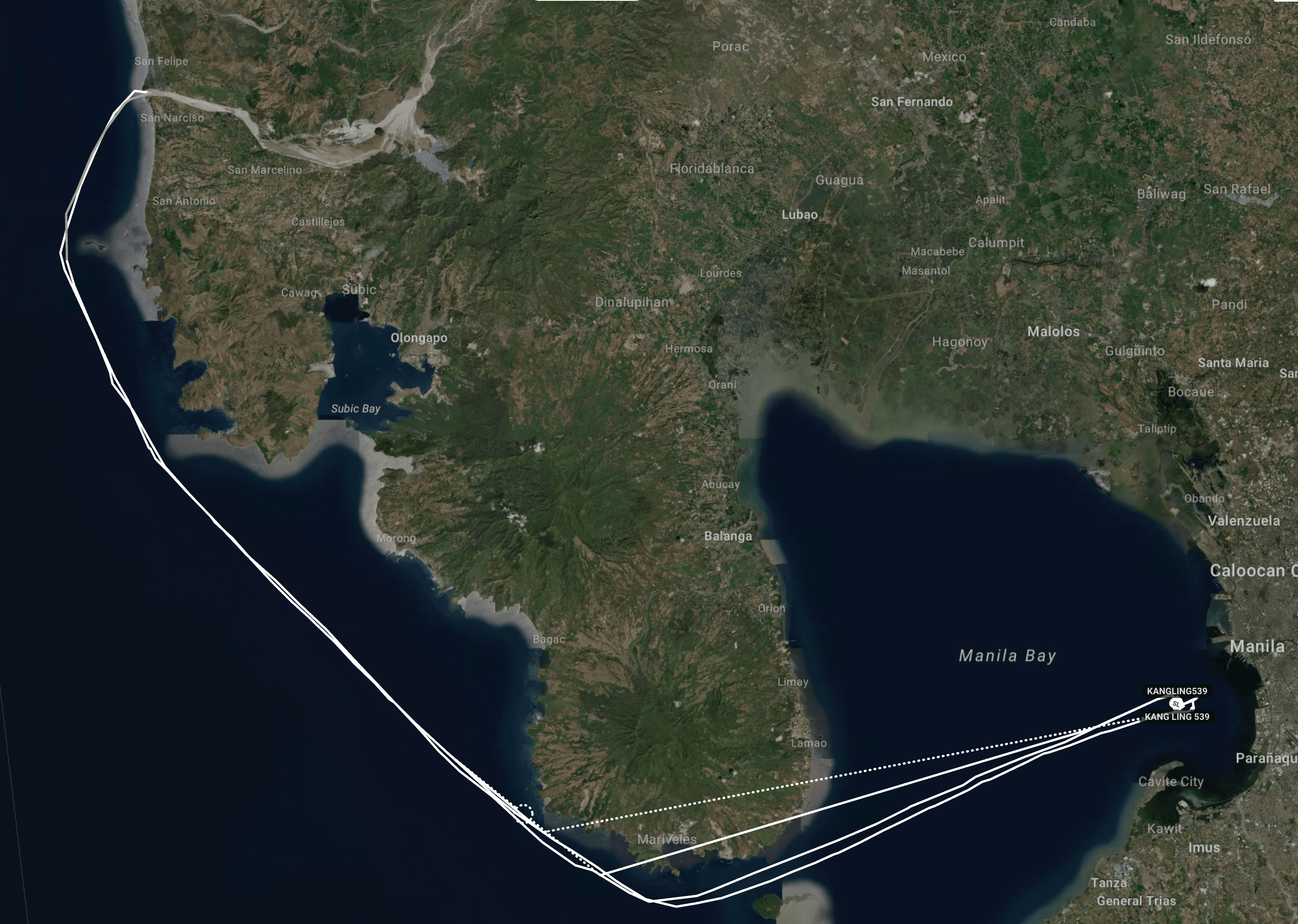
On this weekend's trip, like many before it, the Kang Ling 539 broadcast two identities until it had left Manila Bay and rounded the Bataan Peninsula around midnight, when it abruptly shed its Philippine identity. It broadcast only its Sierra Leone identity on its trip north and throughout its 4-hour dredging operation on the Santo Tomas River on the morning of 3 January. Its Philippine identity would return briefly just before the ship re-entered the bay, then vanish again until finally returning as it anchored again near the reclamation site, where it continues to broadcast its two favorite identities.
Two of the 30 identities SeaLight has linked to the Hydra of Manila Bay.
Why does a single ship need 30 identities? This is a question someone needs to ask the crew, which has been shuttling between the Zambales dredging site and the Manila Bay land reclamation site since its arrival from China in August 2023, then under the flag of Sierra Leone. Or was it actually the Sierra Leone-flagged An Hang 99 ... or one of two China-flagged ships named He Xing 669? Things were confusing from the start, because it was all those things ... and oh, so much more!
In fact, according to International Maritime Organization and China Shipbuilding records this ship is still registered and flagged in China as the He Xing 669, launched in August 2019 at the Fujian New Shenghai Shipyard under IMO number 1023619. It is still on record as a ship owned, operated and managed by Jiangxi Zhongkuang Shipping Co., with no indication in IMO records that it has been deleted or re‑registered under another name or flag.
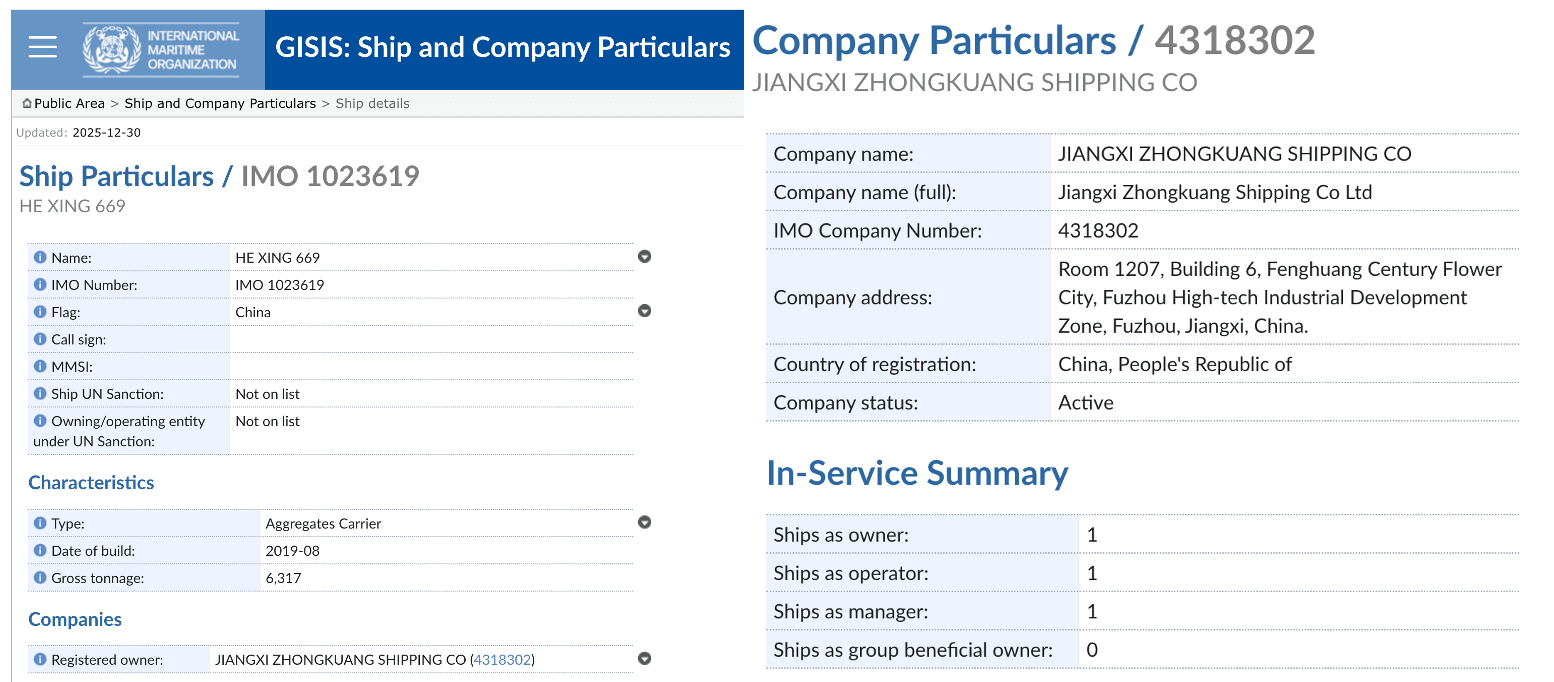
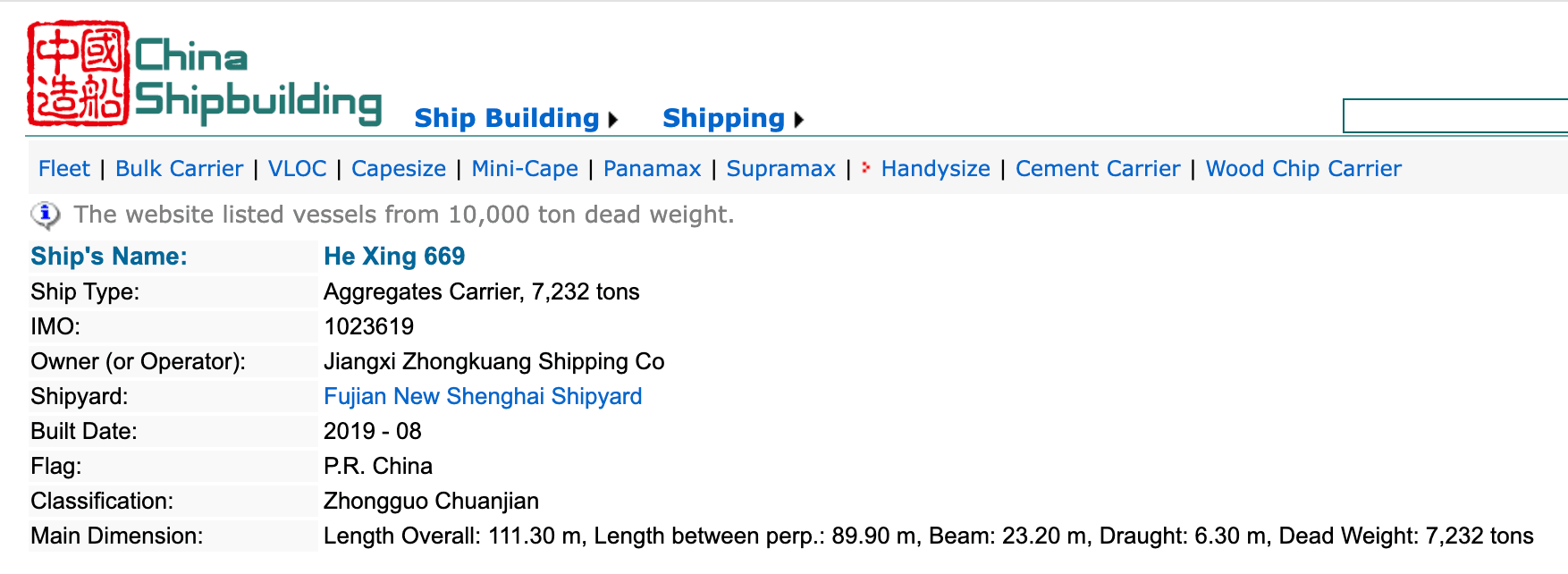
In its early days He Xing 669 hugged the coast of southeastern China, though its Automatic Identification System (AIS) broadcasts changed Maritime Mobile Service Identifier (MMSI) numbers for the first time in mid-2022, from 413212680 to 413292328 (also China-flagged), under which it operated until August 2023.
That's when things really got interesting.
On 5 August 2023, the He Xing 669 left Zhangzhou, China, moving south. It soon went AIS-"dark", reappearing briefly on the evening of 7 August at the edge of the Philippines' exclusive economic zone before disappearing once again. It then emerged on the morning of 8 August off the northwest coast of Luzon under the same name. Oddly, however, it reverted to its old MMSI (413212680). It also added (briefly) another name, flag and MMSI as the Sierra Leone-flagged An Hang 99, which it broadcast simultaneously with He Xing 669 before both disappeared just after noon.

That’s also when a fourth identity appeared—the first of 27 different ‘Kang Ling 539’ identities—hatched just off the coast of the northern Luzon province of Ilocos Sur under the flag of Sierra Leone. That was the identity under which it sailed into Manila Bay and dropped anchor the next day.
On 12 September, Golden Tiger Shipping Agencies, Inc. reported its acquisition of Kang Ling 539, one of nine dredgers now in its inventory. Like many others, Kang Ling 539 was imported under Harmonized System Code 8901 ("Cruise ships, excursion boats, ferry-boats, cargo ships, barges and similar vessels for the transport of persons or goods"), not HS Code 8905 ("Light-vessels, fire-floats, dredgers, floating cranes and other vessels the navigability of which is subsidiary to their main function; floating docks; floating or submersible drilling or production platforms").
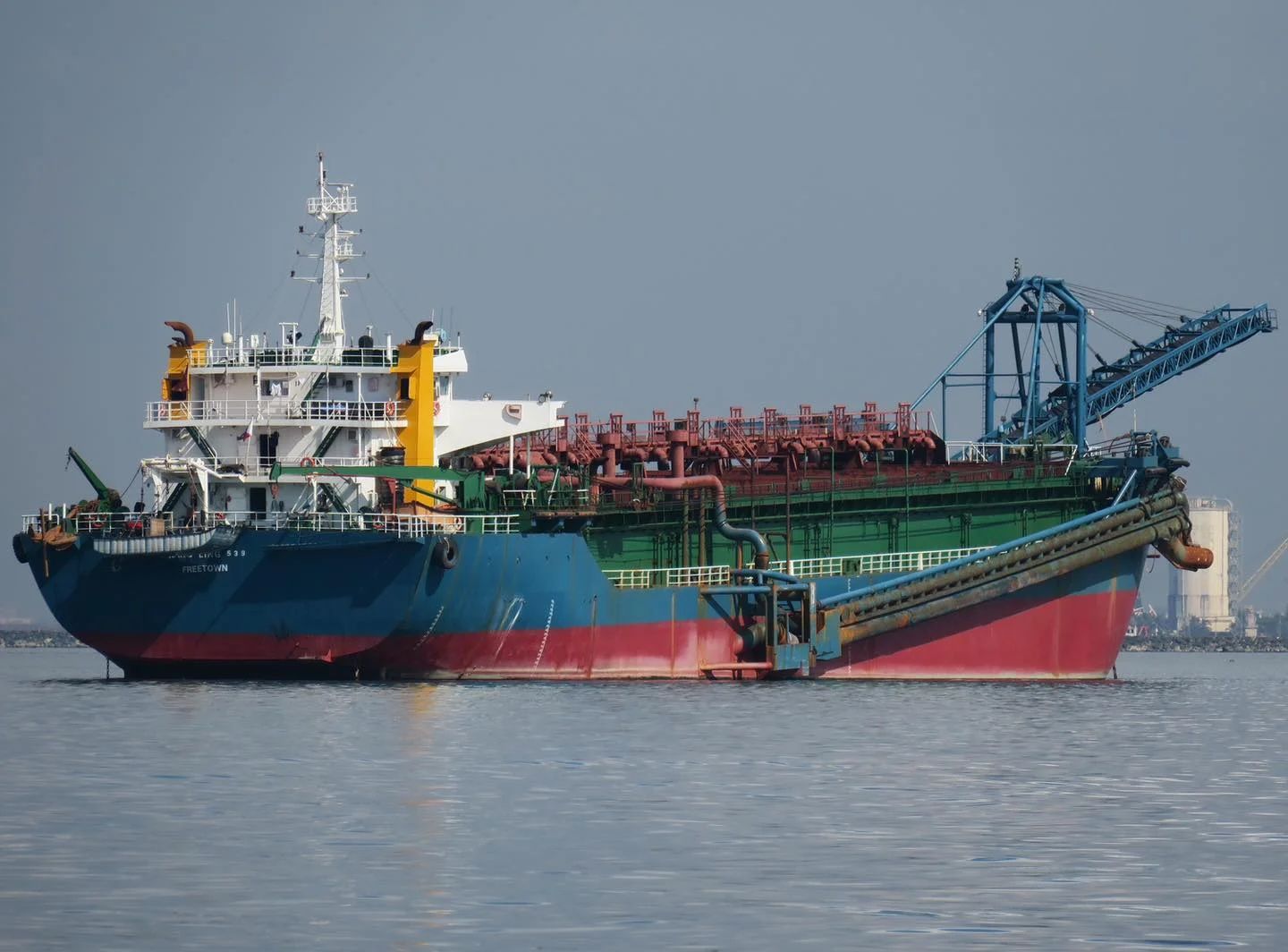
Its AIS broadcast also identified it as a "Cargo" ship, though without a named owner or operator, and with a non-existent IMO number, 3670046.
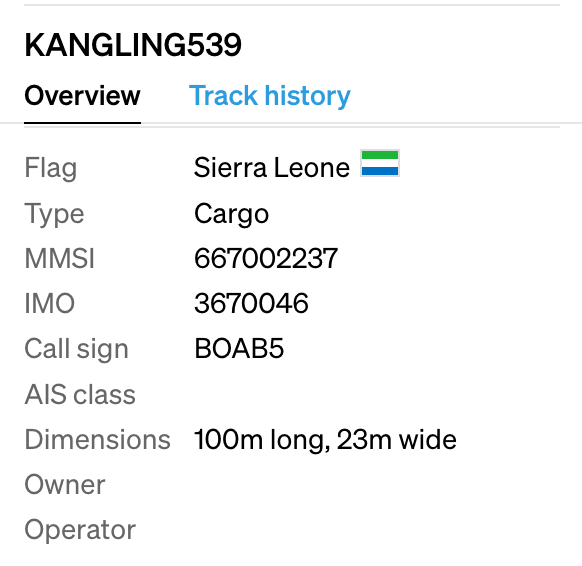
The Kang Ling 539 is clearly a dredger, so why would Golden Tiger want to classify it as a cargo ship? Well, dredging--especially in the Philippines recently--is a controversial business involving extensive government scrutiny, regulation and oversight. So it's clearly easier and cheaper for the company to misclassify the ship. The real question is, why has this ship (and many others like it) been allowed to enter and perform dredging operations for over 2 years under false pretenses?
Regardless, it wasn't long after its arrival before the Kang Ling 539's hydra-headed identities began to multiply, with as many as seven different versions of the same ship materializing in close proximity during the period of 27-30 September 2023, including three identities flagged to Sierra Leone (SL), two to the remote African island nation of São Tomé and Príncipe (ST), and two flagged to no country at all (XX).

Flags of convenience are nothing new in the murky world of commercial shipping, but there's nothing normal about broadcasting multiple identities at the same time. Unless you're the Kang Ling 539, of course ... then it's apparently all too normal.
Over the next 20 months, the Kang Ling 539 continued to broadcast an astonishing number of identities--12 total over that period, "flagged" in AIS to either Sierra Leone (4), São Tomé and Príncipe (3) or no country (5), even as it began to make its regular trips up to the Santo Tomas River dredging site.
Meanwhile, two dredging-related vessel mishaps and a March 2024 Philippine Coast Guard enforcement operation off Zambales that resulted in 17 ship detentions began to draw national attention to the issue of dredger regulation deficiencies, including that of illegal foreign-flagged dredgers. Interestingly, according to news reports only Philippine-flagged ships were detained while foreign-flagged ships were cited and released. This may help explain why Kang Ling 539 doesn't want to be seen as Philippine-flagged while at the Zambales dredging site.
In November 2024, the Philippine-flagged Harvest 89 was boarded and seized near the mouth of Manila Bay by the PCG, which found 13 undocumented Chinese crewmen aboard along with a "Peoples Liberation Army-like" uniform. The ship, which until early November had been registered as the Chinese-flagged Mao Hua 8, was back in operation the next month--presumably with a new crew--and continues to perform dredging operations to this day.
Philippine law treats dredging as a domestic shipping service when it moves sand between Philippine points, so dredgers must meet domestic rules. That means the operator must be at least 60% Filipino‑owned, the vessel must be Philippine‑flagged and registered, and it must sail with a Filipino crew under a Minimum Safe Manning Certificate for domestic voyages. Foreign‑owned or -flagged dredgers cannot legally perform routine dredging and transport inside the Philippines unless they are reflagged, placed under a qualified domestic shipowner and crewed in line with these ownership and crewing requirements.
These laws had clearly lapsed into disuse, so the news of the coast guard sting operations, combined with mounting environmental concerns and rumors that Philippine-sourced sand was being diverted to Chinese land reclamation projects, served to elicit a May 2025 presidential order to probe all dredging operations nationwide. Eight months later that investigation is reportedly still ongoing with no results yet announced by the government.
One thing that did change immediately was that on 17 June 2025 the Kang Ling 539 broadcast its first Philippine-flag AIS signal in Manila Bay. One might be tempted to think that this would mark the end of the ship's errant ways, but since then it has added four more distinct Philippine-flag signals, begging the question of whether any of these is actually legitimately registered somewhere. Nor has the ship given up transmitting other MMSIs, though its favorites appear to be the ones it used this past weekend--548030200 (Philippines) and 667002237 (Sierra Leone). These account for the vast majority of its broadcasts, and are the ones it is broadcasting even now as it sits in Manila Bay.
Given that this one ship has carried 30 MMSIs, and that the only one that seems to be on record with the IMO is the original He Xing 669, it seems certain that something with this ship is badly amiss.
| Flag State | Count | List of MMSIs |
|---|---|---|
| Unknown | 12 | 545933048, 545933055, 545933560, 673859320, 673859832, 673873656, 673873663, 801217860, 801217917, 801219908, 801219965, 801220445 |
| Sierra Leone | 6 | 667000132, 667000189, 667002237, 667002539, 667002717, 667919741 |
| Philippines | 5 | 548030200, 548030207, 548030712, 548044536, 548044543 |
| China | 3 | 413212680, 413212687, 413292328 |
| São Tomé & Príncipe | 3 | 668968260, 668968317, 668968797 |
| Panama | 1 | 356837259 |
This level of MMSI-hopping is so extreme, one has to wonder ... could Hanlon's Razor actually apply? Is it possible that incompetence or some kind of weird equipment malfunction could explain what is happening with Kang Ling 539's AIS broadcasts, which have admittedly produced some very odd location anomalies over the years as well? Well, anything's possible, but given the way it manipulates its Sierra Leone and Philippine flags as it shuttles back and forth to the dredging site, it seems likely that some games are being deliberately played.
Regardless, this would sure seem like a good time for someone to go find out what this Hydra of Manila Bay is up to ... and then maybe ask whether we'll see any results from the president's investigation anytime soon.
Share: