
The University That Said Batanes Is China’s Is Also Training Manila's Chinese Teachers
Ray Powell
Share


On July 8, 2026, a Philippine firestorm erupted after news broke that Jinan University's Center for Philippine Studies had convened a symposium joined by scholars from six other PRC institutions, which “unanimously” concluded that the Philippines' northernmost Batanes islands belong to China. Reaction from senior officials, the media and the public was swift and overwhelmingly negative. Defense Secretary Gilbert Teodoro dismissed the claim as "baseless" and "ludicrous."
Two days earlier, ahead of the 10th anniversary of the Philippines’ arbitration victory over China, the same center's director, Dai Fan, charged in the Global Times that the Philippines was "propagating distorted narratives and erroneous positions regarding the South China Sea issue." Dai, the center’s founder and director since 2016, has had much to say about this issue over the years, having previously written that the Philippines is not only a “historical amnesiac” but a “duplicitous troublemaker stirring the regional pot.”
At this point most Filipinos could be excused for wondering: what exactly is going on at the Center for Philippine Studies, and what else are they doing at Jinan University?
Simply put, Jinan is a foreign influence operation dressed up in academic robes. Its own English‑language "About" page describes it as "jointly constructed by The United Front Work Department of CPC Central Committee, Ministry of Education of the People's Republic of China and Guangdong Province."
The United Front Work Department (UFWD) is a well-documented Chinese Communist Party (CCP) organ responsible for coordinating domestic and overseas political influence to shape political environments in line with CCP interests.
For this university to serve as a vehicle for buttressing China’s expansionist agenda is just the tip of a very large iceberg. Jinan, it turns out, has been a central actor in executing a much broader United Front influence campaign inside the Philippines for years.
This is why Taiwan's Ministry of Education has already barred academic exchanges with it on those very grounds. Taiwan's government understands better than anyone that the problem isn't one of race, ethnicity or language, it's one of being targeted by an aggressive CCP political warfare machine.
The ties that bind: 31 agreements
On April 21, Chinese Ambassador Jing Quan hosted a ceremony at the Chinese Embassy in Manila. Over 100 representatives from five Confucius Institutes, ten Chinese‑education bodies and forty Chinese‑funded enterprises, along with various Filipino‑Chinese associations and PRC‑alumni federations, signed 31 cooperation agreements covering job placement, internships, scholarships, teacher training and digital services.
The keynote address was provided by Huang Duanming (also known as James Wang), Chairman of the Philippine Chinese Education Research Center (PCERC). Huang had first introduced his "Philippine Chinese Education Reform 2.0" plan a year earlier at the April 2025 Shi Wei Peng awards ceremony. The April 2026 embassy event turned that plan into an operational delivery mechanism.
Its organizing demand was a single sentence: Philippine Chinese education needs "an efficient ecosystem coordinated by the Chinese Embassy and consulates in the Philippines, with multiple parties participating." Earlier cooperation with PRC vocational schools and Chinese‑funded enterprises, Huang said, had produced "many signings but hard landings," constrained by "policy, coordination, and model‑fit factors." These 31 new agreements were the delivery mechanism for what previous MOUs had failed to execute.
Three weeks later, evidence of the new design began to show up in specific school contracts. A Fujian delegation filmed by Chinatown News Television (CNTV) arrived at Chiang Kai Shek College (CKSC) and on May 12 signed two five‑year MOUs covering joint training programs, faculty and student exchanges, course development and overseas internships.
An apparently new Manila entity, the Philippine‑China International Education Exchange Center (PCIEEC), signed each of the May 12 agreements as a "cooperating unit." PCIEEC's specific legal standing and institutional basis are, as of this writing, open questions. A search of publicly indexed Philippine Securities and Exchange Commission records returned no evidence of registration, though admittedly these records can be incomplete.
“From loose cooperation to systemic coordination”
Huang's April keynote, "Reconstruction Amidst Change", organized PCERC’s fourth‑decade agenda around four themes: strategic purpose, institutional coordination, school-enterprise implementation and digitally enabled education. Because PCERC has coordinated Chinese‑language teaching in the Philippines since 1991, its ten‑year plan is a roadmap for the entire enterprise, not just for any single campus.
Both sides used similar language from the same stage. Huang called for an ecosystem "coordinated by the Chinese Embassy," while Ambassador Jing described the goal as "to converge resources" and build "an effective platform for information sharing and resource exchange" among Confucius Institutes, Chinese commercial enterprises, education institutions and university alumni federations.
In other words, a Philippine‑registered nonprofit publicly assigned the coordinating role for Chinese‑Filipino schooling to a foreign embassy, which formally accepted it at its own hosted event.
The mechanism has a name: the "Chinese school + Chinese vocational college + Chinese‑funded enterprise" model. Philippine Chinese schools supply students, venues and local grounding. China-based vocational colleges supply curriculum, textbooks, teachers and certification. PRC state and private enterprises supply "customized talent" and job placement. Huang wants vocational tracks to begin at the basic‑education level, so a student can move on one continuous track from a Chinese‑Filipino primary school through a PRC vocational college into a Chinese firm in Manila.
The stated goal is to move "from loose cooperation to systemic coordination" and to produce "a sustainable, replicable, scalable new model of Philippine Chinese education development."
The specific counterparties on Huang's own MOUs point in the same direction. At the April 21 ceremony Huang personally signed three of the 31 agreements: two job-placement and career-development MOUs with the Philippine General Chamber of Chinese-Funded Enterprises and New Hope Bulacan Agriculture, as well as a "cloud services and digital-intelligence solutions" MOU with China Unicom (Philippines).
The Chamber's chairman on that stage was Hu Xinquan, who simultaneously serves as president of Bank of China Manila Branch, another of the day's signatories. China Unicom, the third counterparty, is a state-owned PRC telecom whose U.S. subsidiary was stripped of its operating authority in 2022 on national-security grounds.
This same state-owned PRC company now sits inside the digital-infrastructure track of a Filipino K-12 education plan.
The Fujian connection: “A hotbed of united front and intelligence work”
The Fujian-side counterpart is the China-Philippines Vocational Education Exchange Center (CPVEEC), led by Wu Zichang, a vice chairman of the Fujian Federation of Returned Overseas Chinese (Fujian Qiaolian). CPVEEC launched on December 27, 2025 at Jinjiang Anhai Vocational School, endorsed by the Chinese Embassy and Fujian Qiaolian. Three Philippine institutions signed as founders: CKSC, the Philippine Tiong Se Academy and the Federation of Filipino-Chinese Chambers of Commerce and Industry (FFCCCII).
CPVEEC and PCIEEC operate as paired centers. Chinese-language coverage of the May CKSC and PCC delegation lists both in the same field team: Wu directs CPVEEC and a separate PCIEEC "liaison department general manager" travels alongside him. The Fujian institutions Wu brought to the May 11–12 school visits were Fuzhou University of International Studies and Trade and Xiamen Nanyang Vocational College, both private Fujian colleges.
CPVEEC's institutional sponsor, Fujian Qiaolian, is the provincial chapter of the All-China Federation of Returned Overseas Chinese (ACFROC), which the Australian Strategic Policy Institute links to the UFWD. ASPI singles out Fujian as "a hotbed of united front and intelligence work targeting Taiwan and the Hokkien-speaking diaspora", the exact community CPVEEC targets in Manila.
The flagships: Chiang Kai Shek College and Philippine Cultural College
The UFWD's penetration of Manila's two flagship Chinese-language schools leaves the deepest documentary trail. PCC, founded in 1923, is the country's oldest Chinese-Filipino secondary school. CKSC opened in 1939 and ironically still carries Chiang Kai-shek's name, having looked primarily to Taipei for most of the 20th century. That connection now seems all but severed in favor of Beijing.
At the Chinese Embassy's Basic-Level United Front Cooperation and Communication ceremony on April 21, both PCC and CKSC signed direct bilateral MOUs with the Confucius Institutes at Adamson University and Bulacan State University. These are university-hosted CIs entering K-12 agreements at a foreign embassy ceremony, outside the university-level governance channel that has been the primary unit of scrutiny for every major CI investigation. Confucius Classrooms in K-12 settings have existed since 2007, and CIs have signed K-12 arrangements before, but the concerns that closed CIs across North America and Europe now attach to schools with less leverage and virtually no public reporting requirements.
Three weeks later the Fujian side carried the package outward. The delegation CNTV filmed visited PCC on May 11 and CKSC on May 12, and both schools signed five-year frameworks with the same two Fujian institutions – Fuzhou University of International Studies and Trade and Xiamen Nanyang Vocational College – covering the same areas of cooperation, with PCIEEC named "cooperating unit" each time.
Nor was this the first such visit to Manila. In late November 2025, Liu Siyi, another Fujian Qiaolian vice chairman, ran a parallel sweep through PCERC and the Federation of Filipino-Chinese Associations of the Philippines, pitching Chinese-language and vocational-education cooperation.
PCC's mainland partners include Huaqiao University in Quanzhou. Huaqiao's own English-language site describes it as "directly affiliated with the United Front Work Department of the CPC Central Committee," and records a 2019 "co-construction framework" jointly with the UFWD, the Ministry of Education and the Fujian Provincial Government — the same UFWD-MOE-Fujian pattern CPVEEC replicates through Fujian Qiaolian.
As with Jinan, Taiwan's Ministry of Education barred exchanges with Huaqiao in February 2025, also citing its UFWD ties.
CKSC's shift has been sharper. Since 2023 it has signed just a single Taiwan agreement against a lengthening string of PRC-linked ones: a Fujian Normal University overseas internship base; designation as the country's Chinese proficiency test center under the Center for Language Education and Cooperation; a founding role in CPVEEC; and the April and May Fujian MOUs already described.
The “Blood Generation Plan” for teachers
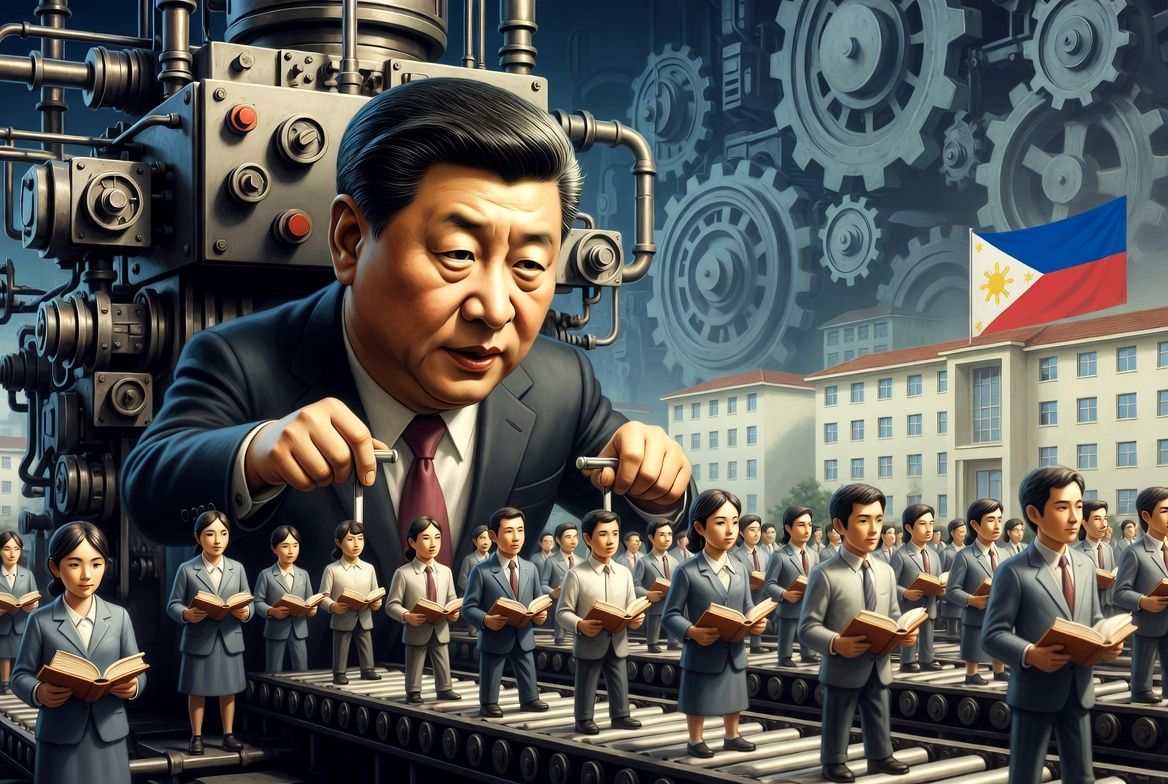
PCERC's largest program is its longest-running. Since 1991 the center has run a "Blood-Transfusion Plan" that as of 2022 had already imported more than 5,000 mainland teachers to fill Chinese school posts. In 2004 it added a matching "Blood-Generation Plan," reported in the Philippine press, which sends Filipino-Chinese high-school graduates to Chinese universities for four-year Chinese-language teaching degrees on condition they return home to teach for at least five years.
A July Chinese Commercial News report claims the Blood Generation Plan has trained 336 students from 44 Chinese-Filipino schools. At the July ceremony where 19 newly returned teachers began pre-service training, two Chinese Embassy consular officers attended and Huang explicitly linked the pipeline to his "Philippine Chinese Education Reform 2.0" agenda.
A 2024 report breaks down that year's 56-student cohort: 43 at Jinan University, 6 at Huaqiao University, the remainder at Minnan Normal University and Beijing Language and Culture University. Both Jinan and Huaqiao self-report the same UFWD-MOE-provincial governance pattern, and Taiwan's Ministry of Education barred both from academic exchanges on those grounds.
The same Jinan University whose Center for Philippine Studies coordinated the June 30 Batanes symposium is therefore also the single largest training site for the Chinese-language teachers going into Philippine Chinese-Filipino schools. Both the territorial claim and the teacher pipeline share a UFWD-directed institutional home.
Huang has been explicit about the goal. He is on record in a 2022 ACFROC report saying his graduates return with "a strong sense of responsibility and ethnic identity" — "minzu rentong" in the original, a term Jamestown's February 2026 mapping report describes as United Front shorthand for a "Chinese identity" that "aligns with the CCP's preferred definitions."
The chief architect
Huang Duanming links several parts of the network. He chairs PCERC, signed three of the 31 April MOUs, advanced the vocational training pivot in a December 2023 interview, and has been recognized as a "Friend of the Chinese Embassy" since 2021.
In 2025 Huang also fronted a PCERC-branded essay contest for public and private Philippine school students as part of a United Front-coordinated anti-Japan propaganda campaign, co-organized with the UFWD-associated Philippine Council for the Promotion of the Peaceful Reunification of China.
PCERC's institutional ties run directly to Beijing. Its own materials describe close collaboration with the Chinese Embassy in Manila and with China's Overseas Chinese Affairs Office, and the People's Daily overseas-affairs paper reported a formal PCERC-OCAO online-class cooperation in 2022. OCAO's overseas-Chinese-affairs functions were subsumed by the UFWD in the 2018 restructuring.
CNTV’s coverage of the November 27, 2025 Fujian Qiaolian visit reported that "since its establishment, the PCERC has assisted Chinese schools in carrying out various tasks, including textbook compilation, teacher training, evaluation mechanisms, and cultural activities." Among the delegation, CNTV's own captions identify Wu Zichang as a "part-time Vice Chairman of the Fujian Provincial Federation of Returned Overseas Chinese." The same Fujian Qiaolian official directs both the sending-side CPVEEC and the receiving-side PCIEEC. CNTV places him inside PCERC on an official Fujian Qiaolian trip.
PCERC's reach may extend beyond the Chinese-Filipino community. In a December 2023 China News Service interview, Huang claimed PCERC's "China Enters the Classroom" competition, running since 2004, had led "many" mainstream Philippine middle schools to include books popularizing Chinese history and culture in their required social-studies coursework.
PCERC is also building itself a grand new home. On June 3, 2025 it broke ground on the Philippine Chinese Language and Culture Palace on Ramon Magsaysay Boulevard in Manila. Then-Ambassador Huang Xilian personally headlined the ceremony and framed the palace as a "window for showcasing Chinese culture" advancing his embassy initiative to "promote mutual understanding and affinity between the Chinese and Filipino peoples." People's Daily covered the groundbreaking with photos credited to the Chinese Embassy in Manila.
The donation ledger published by Chinese Commercial News names Chinese-Filipino clan associations, alumni federations and business figures, including multi-billionaire and Philippine Airlines owner Lucio Tan. A PCERC preparatory committee under Cai Jianli, also named in that ledger, manages construction. The Chinese-language Manila press has tracked the ledger for three years. The English-language Manila press has not.
The bottom line
CCP-linked bodies now hold substantial roles in teacher training, language testing, curriculum development, internships, and job placement across Chinese-Filipino education. No law has been broken. No single MOU is decisive. What the record shows is that an embassy-endorsed United Front apparatus has become the main broker between mainland institutions and the Chinese-Filipino school system — in a country whose regulators have no transparency regime built for this pattern, and have not yet begun asking the questions.
Any Philippine government response has to leave Chinese-Filipinos as a community out of it. The problem is a foreign state's arrangements and its interference in Philippine institutions, not an ethnic group, and the tools have to match. The Philippine legislature is already considering counter-FIMI measures that draw the necessary distinctions: between covert interference and open influence; between prohibition and disclosure; and between the arrangement and the actor's ethnic identity. Which specific instrument the Philippines chooses is for Filipinos to decide. What the pattern documented here calls for is transparency of foreign arrangements, regardless of the counterparty’s country and regardless of the Philippine school's community character.
Jinan is not just the university whose scholars claimed Batanes belongs to China. It is a lead actor in the campaign running through the Chinese-Filipino school system and, on PCERC's own account, into mainstream Philippine classrooms as well.