
Beijing's Toxic Sanctimony

Ray Powell
Share


Of all the brazen gaslighting Beijing engages in to distract from its maritime aggression, there may be none more outrageous — and more revealing — than its reflexive habit of accusing its Southeast Asian neighbors of violating the 2002 Declaration on the Conduct of Parties in the South China Sea.
The latest example arrived yesterday, when the Chinese Embassy in Manila reacted to a small civilian mission by the Atin Ito! Coalition — which briefly held up a Philippine flag on an uninhabited sandbar near Pag-asa Island — by declaring that China would "firmly uphold the sanctity of the DOC," while accusing the Philippines of violating "relevant provisions" of the same.
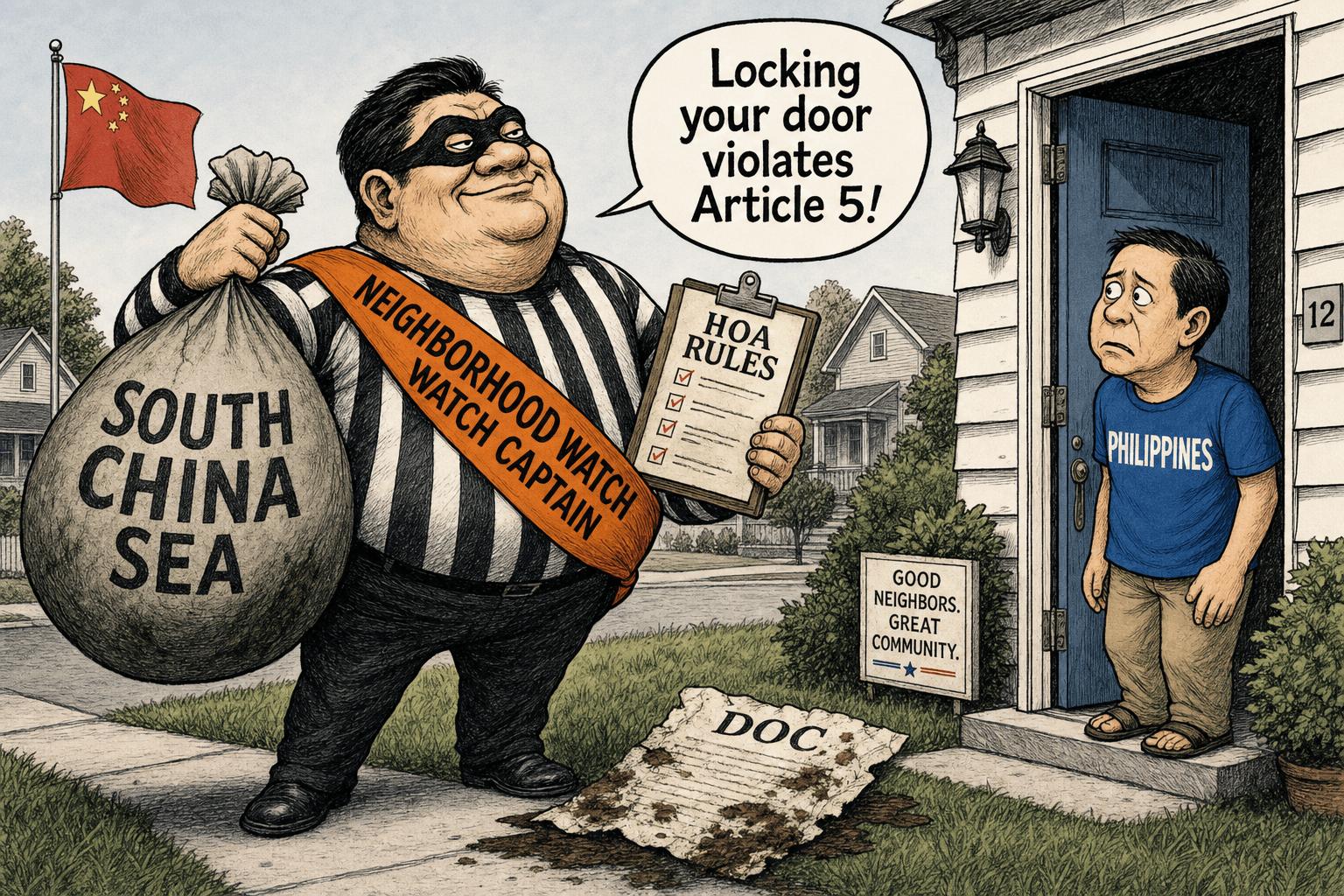
Such sanctimony — coming from the DOC's chief violator — is like a burglar appointing himself neighborhood watch captain, while self-righteously explaining that locking your doors against him violates homeowners association rules.
Why the DOC Failed to Constrain China
The 2002 DOC was signed by China and the ten members of ASEAN as a political confidence-building measure. It was neither a treaty nor legally enforceable. Rather, it was a promise of mutual restraint.
That promise mattered. The DOC emerged after China's 1995 occupation of Mischief Reef — a feature well inside the Philippines' lawful exclusive economic zone — shocked Southeast Asia and laid bare the absence of even basic behavioral guardrails in the South China Sea.
Its core commitments are simple. The parties promised to resolve disputes peacefully and without the threat or use of force. They promised to respect freedom of navigation and overflight under international law — especially the U.N. Convention on the Law of the Sea (UNCLOS). They further promised to "exercise self-restraint" in activities that would complicate or escalate disputes — including, explicitly, refraining from inhabiting presently uninhabited features.
The DOC was also meant to point the parties toward a future, stronger Code of Conduct (COC) — one that many hoped would be legally binding and that would put real enforcement behind those principles.
Why the COC Has Never Arrived
Twenty-four years later, the COC is still not remotely close to being completed despite the annual kabuki theater that surrounds it as each incoming ASEAN chair pledges itself to see it through. Each year, those of us who follow this closely (and thus carry the "pessimist" label) nod wearily and wait for the all-too-predictable outcome.
Our pessimism arises from the decades of futility as much as the unresolved questions, which are not minor ones: geographic scope, legal status, enforcement, dispute settlement and its relationship to UNCLOS. China has pushed for provisions that would restrict cooperation with outside powers and leave enforcement ambiguous. Such an agreement would pave the way for Beijing to exploit the document, and to dilute, sideline and politically bury its neighbors' greatest legal leverage: the 2016 arbitral ruling that systematically dismantled Beijing's vast extralegal claims.
Meanwhile, the very behavior the DOC was meant to constrain has only accelerated. Since 2002, China has seized effective control of Whitsun Reef, Scarborough Shoal and Sabina Shoal; dredged roughly 3,200 acres of artificial land across seven Spratly features, then militarized those outposts after Xi Jinping publicly promised not to; intermittently blockaded the Philippine garrison at Second Thomas Shoal; and repeatedly both threatened and deployed force against Philippine government and civilian vessels.
Each of these actions undermines the DOC's clear text as well as its central purpose. All of them reveal the same thing: Beijing treats the DOC with extreme contempt — not as a mutual and legal restraint, but as a unilateral and political one.
Gaslighting
This is what makes the embassy's sanctimony so revealing. Beijing is not merely violating the DOC — it is rebranding its own blatant violations as enforcement, and its adversaries' limited countermeasures as the real violations.
It does so by invoking the DOC's logic on "presently uninhabited features" against two civilians holding up a flag on a sandbar (or the resupply of a grounded ship at Second Thomas Shoal ... or a coast guard ship anchored in Sabina Shoal ...), while insisting that turning once-pristine reefs into military bases is just fine.
It equates the Philippines' flag display as an "illegal landing" on an uninhabited feature, while its own coast guard has done the exact same thing.
The purpose of this inversion is not to win a legal argument — it is to normalize the lie by incessant repetition. If Beijing can accuse others of DOC violations often enough, loudly enough, and in near-identical phrasing across multiple channels, it conditions its audience to accept the possibility that ... just maybe ... China is the aggrieved party and its neighbors are being unreasonably recalcitrant.
Why We Can't Have Nice Things
The DOC was even rolled out in opposition to the 2016 arbitral case, which was in all ways properly filed and decided under the rules laid out in UNCLOS. This is crucial to understand, because it sets up the idea that the regional agreement (DOC) was not additive to the global one (UNCLOS), but rather in opposition to it.
This is why a weak COC would likely be even worse than none at all, since it would simply give Beijing one more lawfare tool with which to leverage UNCLOS — ASEAN's best legal defense — out of the South China Sea discussion entirely. A party that behaves this way toward a non-binding agreement is telling you exactly how it will behave when armed with an imperfect "binding" one.
The criticism of the DOC has always been that it lacked teeth. But the deeper problem is that Beijing does not accept the premise of mutual restraint, but only restraints on others. That is the very definition of a bad-faith negotiator. It is also why the long-promised COC — whatever it might eventually say — would fail to constrain China's conduct unless it is backed by something China has consistently refused to accept: an authority that sits above its own political will.
In other words ... it would fail to constrain China's conduct.
A Call to Clarity
When Beijing invokes the "sanctity" of the DOC, our response ought to be more than mere outrage. It ought to be the galvanizing clarity that China is already the DOC's most prolific violator; that its accusations are not legal arguments but gray zone tactics; that every lecture about sanctity is in fact a confession — a tell — of how little Beijing intends to be bound by any agreement it signs.
The region's task is not to argue with Beijing's accusations on their merits. It is to name the tactic, refuse the premise and stop treating its sanctimonious rhetoric as though it were a good-faith dispute.