
China’s Fishing Fleet Off Vietnam: Commercial Activity, State-Backed Pressure

Ariana L.
Share


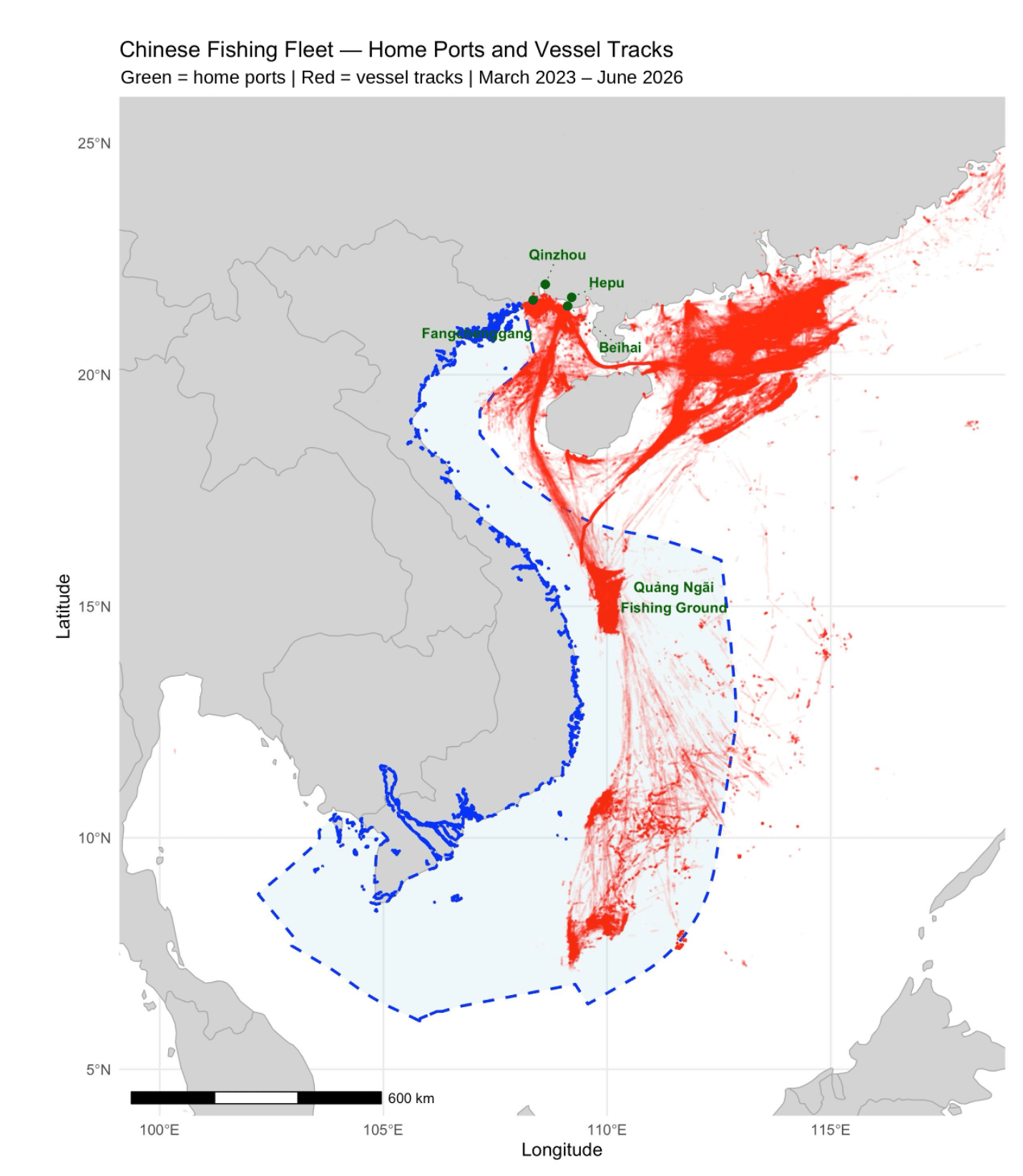
A fleet of roughly 100 Chinese fishing vessels has been making repeated deployments inside Vietnam’s exclusive economic zone (EEZ), operating within 28 nautical miles (NM) of Lý Sơn Island. The island, which hosts a vibrant fishing community, lies a mere 15 NM off the coast of central Vietnam’s Quảng Ngãi province.
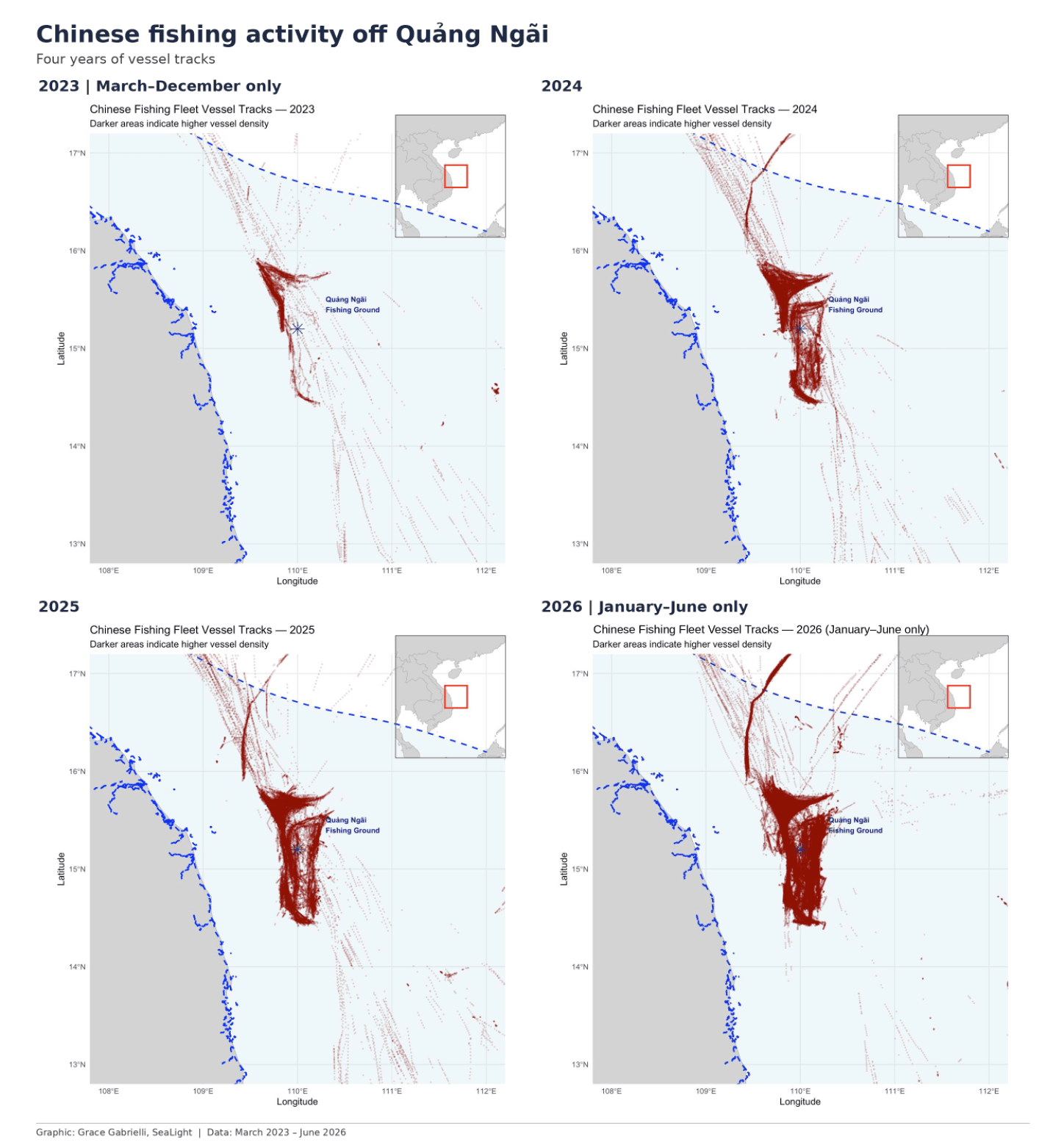
SeaLight tracking and analysis by Grace Gabrielli (which was first reported last month in Vietnamese and Chinese-language reports by BBC News) shows a growing presence of vessels originating from the Chinese coastal region of Guangxi. Analysis of the tracking data reveal the path of vessels which loitered off Quảng Ngãi between March 2023 and June 2026. Most appear to be fishing. However the presence of an accompanying Chinese state vessel gives the operation a strategic dimension: commercial activity backed by state power near Vietnam’s coast.
What the tracking shows
On some days in 2026, SeaLight recorded a fleet of more than 40 Chinese fishing vessels in the area—substantially than in earlier years, and the increase shows no sign of slowing.
Under the United Nations Convention on the Law of the Sea (UNCLOS), Vietnam has sovereign rights over fisheries in its exclusive economic zone. Foreign vessels retain navigation rights but are expressly prohibited from fishing without Hanoi's permission.
At issue is not simply that Chinese vessels are appearing near Vietnam’s coast. The concern at present is their unauthorized fishing activities, with the implicit support of Beijing, increasingly evidenced by the Chinese state vessel accompanying them.
A fleet that runs on a calendar
The vessels off Quảng Ngãi do not remain year-round but instead follow a seasonal pattern. The data reveals how they transit between ports and fishing grounds, returning to China before deploying again.
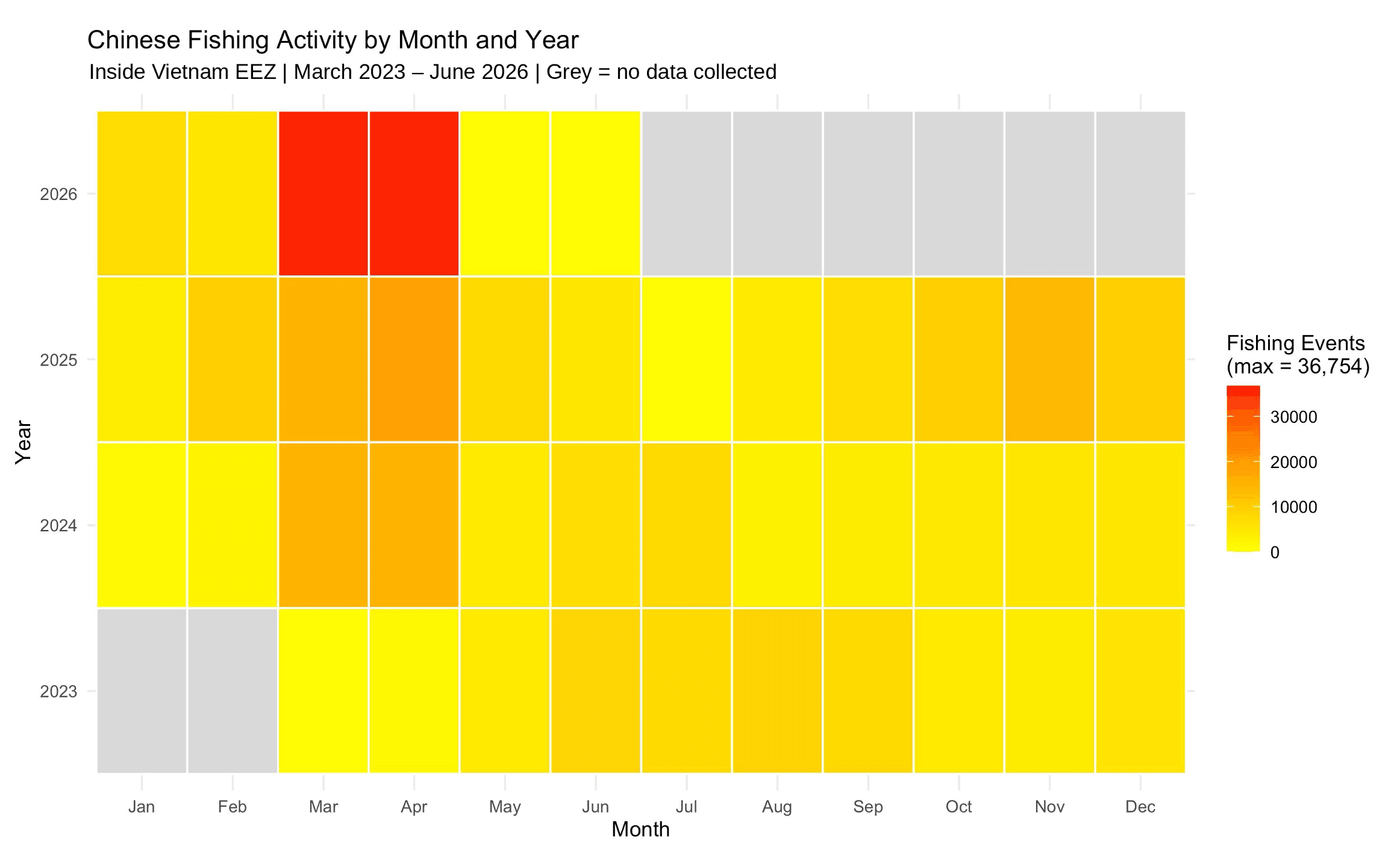
SeaLight’s monthly data for these vessels shows fishing activity peaking each March and April since 2024, reaching its highest levels to date in March and April 2026. Carlyle Thayer of the University of New South Wales told BBC News Vietnamese how those movements align with the fishing calendar:
- The fleet peaks in March and April, then begin to drawdown in late April.
- China’s unilateral fishing moratorium runs from May 1 to August 16.
- After the moratorium ends, the vessels return.
- Around the Lunar New Year (late January to mid-February) vessels return to China before heading back to sea
Much like the zodiac, China’s annual fishing pattern sets the rhythm of fishing activity inside Vietnam’s EEZ. The boats come and go, but the influence of their presence lingers as China effectively extends its reach into waters where Vietnam holds the resource rights.
Not just fishermen
According to SeaLight Director Ray Powell, most of the tracked fishing vessels appear to engage in fishing activity. But the fleet does not operate alone.
SeaLight also identified a Chinese government vessel whose seasonal movements mirrored those of the fishing fleet. No fishing activity was recorded for that vessel. Powell assessed that the vessel’s type and behavior was consistent with an escort role. Its presence, he argued, signals that Beijing monitors and tacitly sanctions the operation and would defend the fishing vessels if necessary.
Commercial fishing and state pressure can reinforce each other. The fishing fleet maintains a recurring presence, while the accompanying state vessel signals that any effort by the Vietnamese to put a stop to the fishing could trigger a confrontation with China. Judging by the distance its own government ships keep from the Chinese fleet, Vietnam appears to have no appetite for such an incident.
Thayer told BBC that the wider fleet likely includes a mixture of commercial crews, subsidized maritime militia and maritime law-enforcement assets, while noting that clear photographic evidence was lacking.
Why Quảng Ngãi, and who bears the cost
Quảng Ngãi supports a large fishing industry, with nearly 5,000 registered fishing vessels as of May 2026, according to the Vietnam News Agency. Its fishing communities have long worked grounds extending to the Paracel and Spratly Islands.
On September 29, 2024, the Quảng Ngãi fishing boat QNg 95739 TS was attacked near the Paracels. Chinese personnel beat the crew and took their nets, equipment and several tons of catch, BBC News Tiếng Việt reported. At least 10 crew members were injured. China’s Foreign Ministry told Reuters that Vietnamese boats had fished illegally in Paracel waters and that Chinese authorities had taken measures to stop them, without directly addressing the reported violence.
Thayer described Quảng Ngãi fishermen making the voyage to the Paracels under cover of darkness to avoid Chinese detection. Citing SeaLight data, he said China built a “wall” of maritime militia and law-enforcement vessels to stop them. Some crews have shifted toward the Gulf of Tonkin; others have ranged as far as waters around Indonesia’s Natuna Islands.
According to Thayer, fishermen have told reporters that calls for help during confrontations went unanswered or came too late, and that Vietnamese patrols were sparse or absent. Longer journeys and reduced access to familiar fishing grounds compound the risks they face at sea.
For fishing families, maritime pressure is measured in more than lost catches. It means diminishing access to traditional fishing grounds and uncertainty over whether they will return home safely.
Vietnam’s restrained response
Vietnam has also repeatedly protested China’s unilateral fishing ban. On May 5, 2026, Foreign Ministry Spokesperson Phạm Thu Hằng reaffirmed Hanoi’s position that the ban is illegal, and called on China to respect Vietnamese fishing rights under UNCLOS.
The dispute extends beyond fishing. Vietnam has objected to Chinese construction in the Paracels, where reclamation at Antelope Reef is expanding Beijing’s physical presence. On September 3, China’s foreign ministry replied that Vietnam had no right to comment.
Thayer’s assessment is blunt: diplomatic protests have limited effect when China holds such a substantial advantage at sea. Hanoi continues to raise these disputes when leaders meet, but both sides have agreed not to let the issue derail the wider bilateral relationship.
Powell described the diplomatic tête à tête as “controlled,” the issue having been compartmentalized to preserve broader relations. Public scrutiny is muted, while deep disagreements persist behind closed doors.
The contrast with the Philippines is striking. Manila’s “assertive transparency” approach publicizes confrontations through photographs, video and accounts from personnel at sea. Vietnam generally releases far less material documenting such encounters.
Powell noted that Vietnam’s approach can help contain immediate tensions. The cost, he said, is that China’s slow, persistent strategy has steadily compounded its encroachments on Vietnam’s claims and sovereign rights. Without images and detailed public accounts, individual confrontations are harder to scrutinize and the wider pattern is easier to overlook.
The strategic context
Thayer sees a strategic rationale alongside the commercial fishing activity. China’s expanding facilities in the Paracels strengthen its ability to maintain a presence and monitor surrounding waters. The fishing vessels both justify and contribute to that presence, while also possessing the ability to gather intelligence.
Powell offered another motivation: increased pressure off Quảng Ngãi may also be an indirect response to Vietnam’s own island-building in the Spratlys. Rather than confronting Vietnamese reclamation directly, Beijing can demonstrate its leverage closer to Vietnam’s coast.
The mechanism is straightforward. Repeated fishing deployments sustain a Chinese presence. State backing raises the cost of any potential response. Vietnam faces a choice between tolerating the activity and risking a confrontation to stop it.
For Vietnamese fishermen, access to fishing grounds and safety at sea is a make-or-break proposition. Some fishermen may simply choose to stay home as China’s coercive reach extends into Vietnam's waters. SeaLight’s tracking ensures that both the fishing fleet and the state presence behind them are harder to keep out of sight.
About this report: This report is based on SeaLight vessel tracking using Starboard Maritime Intelligence, and data analysis and visualization by Grace Gabrielli. SeaLight shared its findings with BBC News, which first reported them in Vietnamese (September 19, 2026) and Chinese (September 25, 2026) with its own graphics. This is the first English-language report on the activity, and all graphics are by Grace Gabrielli for SeaLight. Comments from Carlyle Thayer are from his interview with BBC News.


