
Embassy Echo Chamber II: Editor Gets Award for Serving Beijing's Interests
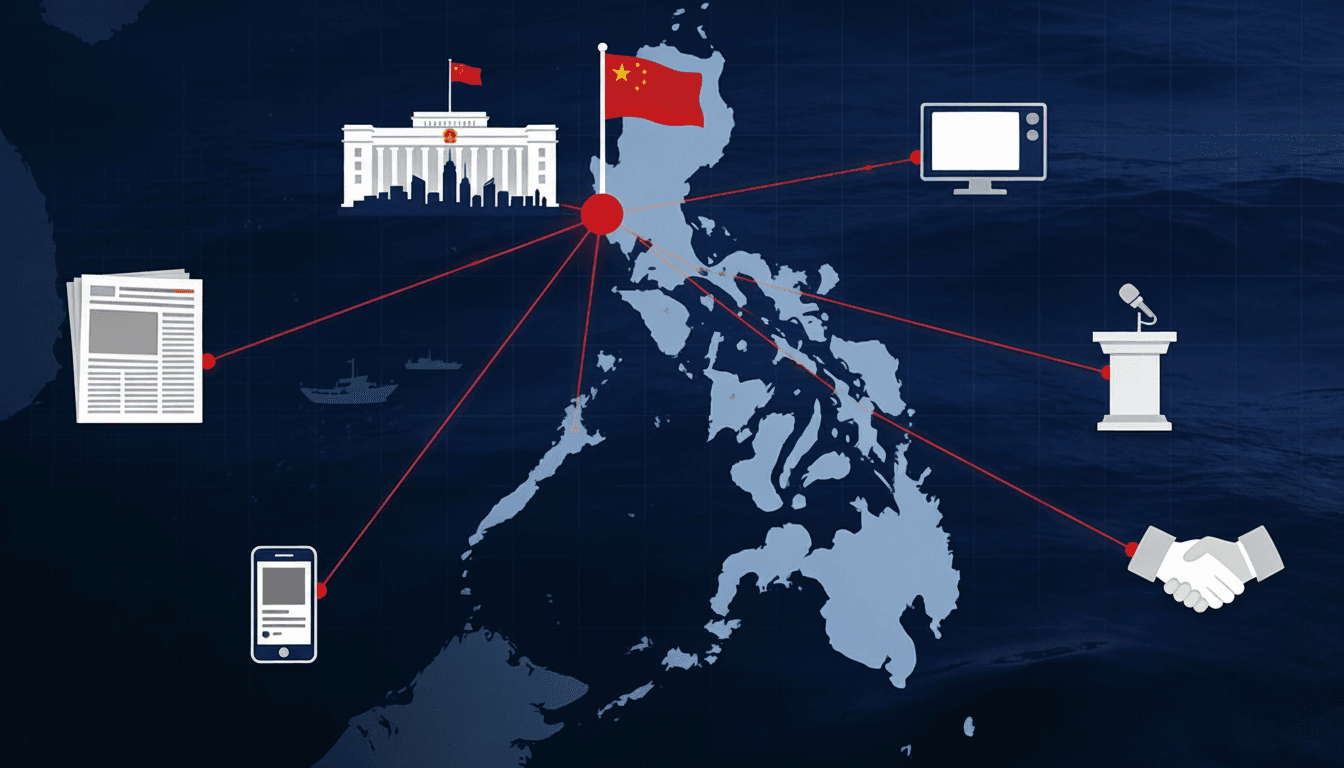
Ray Powell
Share


"Tell me again how the Chinese embassy is not running the Chinese language news in Manila."
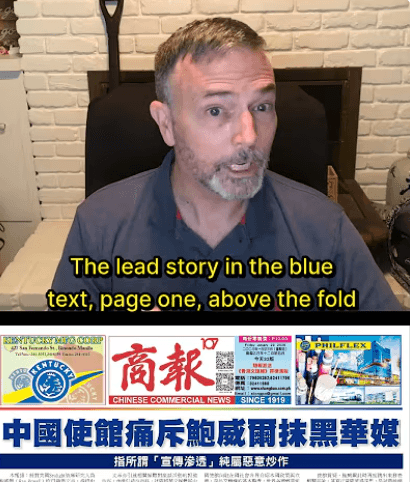
That was my reaction last month after documenting how a Manila-based media outlet responded to my research on embassy control of local Chinese-language media. The Chinese Embassy fired back on social media, calling my work "baseless" and "groundless." The very next day, Chinese Commercial News ran a front-page story parroting the embassy's talking points.
As I explained in my response video (which you can watch here), this was the case of a newspaper accused of echoing the Chinese government, which then responded by echoing the Chinese government's claim that the Chinese media doesn't echo the Chinese government.
The funny part is I actually barely mentioned Chinese Commercial News in my previous column--the one that earned me the first in a series of social media broadsides from the embassy's "Wolf-Warriors".
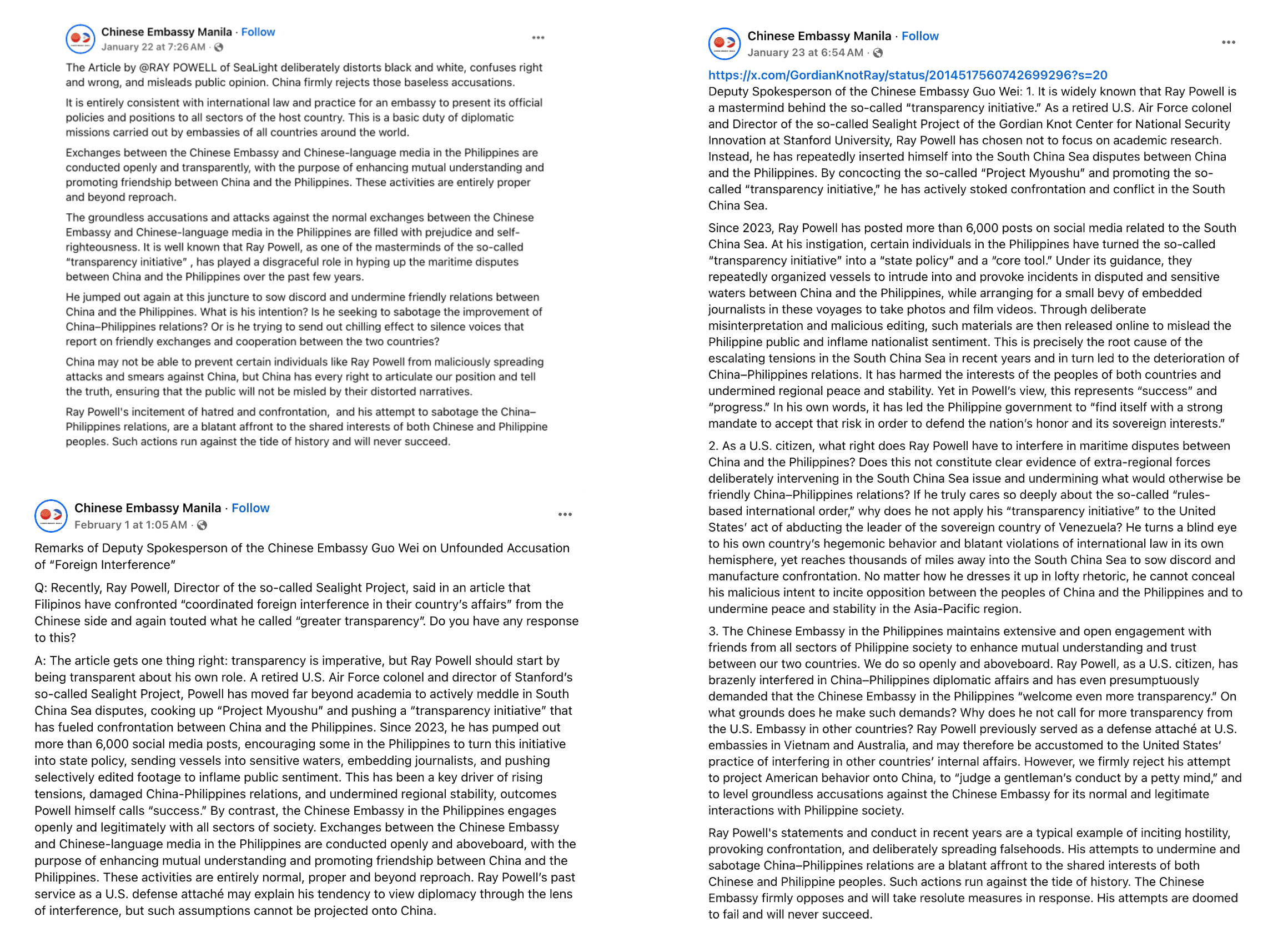
That particular post focused primarily on two other outlets, United News and Chinatown News TV. The truth, however, is that I could have started with almost any of the Mandarin-language outlets in Manila to demonstrate how thoroughly they have been co-opted by the Chinese Communist Party and the Chinese Embassy, and how they now shamelessly carry Beijing's water.
In fact, the embassy has helpfully offered us the opportunity to spotlight yet another example--Manila's most-read Mandarin-language newspaper, World News, upon whose editor they have just lavished special honor.
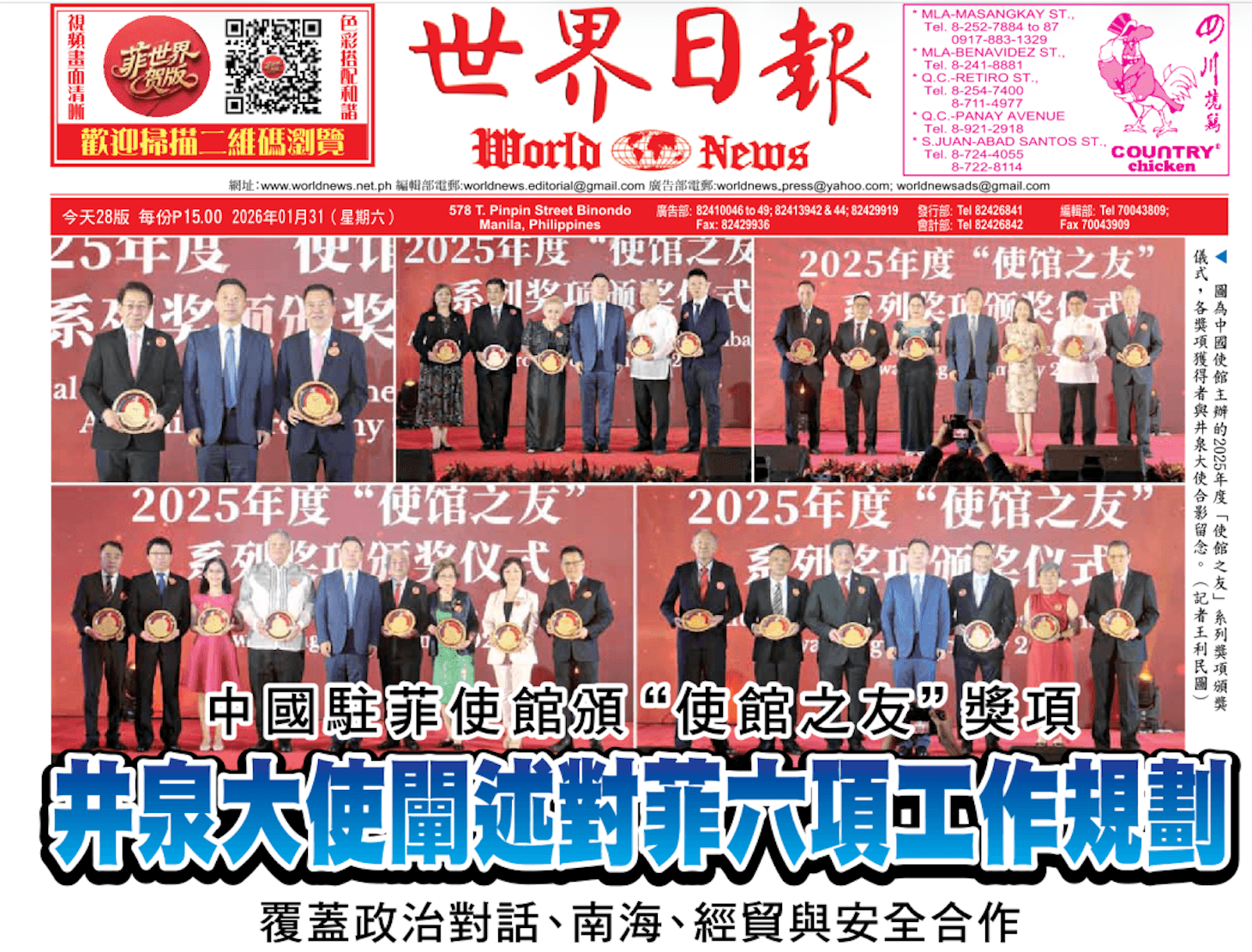
On January 30th, the Chinese Embassy held its annual "Friends of the Chinese Embassy" awards ceremony at the Dusit Thani Hotel. Among the recipients of the "Outstanding Dedication Award" was World News Editor Fan Zongding (范宗鼎).
So what dedication has Mr. Fan been saying to earn him this recognition? Let us sample just a few of his recent hits:
- In February 2021, when China delivered Sinovac vaccines to the Philippines, Fan lamented how, while U.S. provides only "deadly weapons", China's military aircraft bring "life-saving vaccines". He closed his lament with this gem: "The friendship between the two countries and two peoples shines like ten thousand rays of light, piercing through the filth and darkness, spreading the warmth of hope across this land."
- In October 2017, Fan traveled to Beijing to cover the 19th CPC National Congress and filed reports making Party political theater "relevant to the Philippine Chinese community."
- In August 2025, during a government-sponsored media tour to Mao Zedong's former residence, Fan gushed to Chinese state media: "Mao Zedong is the leader of China's revolution. From him we can learn life's greatest wisdom, life's greatest resilience."
So I think it's fair to say that World News editor Fan Zongding has well earned his "Friends of the Chinese Embassy" award.
Of course Fan's boss, World News President Wu Zhongzhen (吳仲振), doubtless approves. After all, he made his mission for World News abundantly clear when covering a major CCP event in 2022:
The 20th National Congress of the Communist Party of China was successfully convened in Beijing, and the World Daily of the Philippines extends its warmest congratulations. As the largest Chinese-language newspaper in the Philippines, the World Daily has always paid attention to and supported the development and progress of its ancestral homeland, leveraging the advantages of Chinese-language media to tell stories of mutual support between overseas Chinese and the people of their host countries, and to promote cultural exchanges between the people of China and the Philippines.
"The central task of the Communist Party of China is to unite and lead the people of all ethnic groups across the country to build a modern socialist country in all respects and achieve the second centenary goal, and to comprehensively advance the great rejuvenation of the Chinese nation through Chinese-style modernization." This is the part of the report to the 20th CPC National Congress that impressed me the most. The world today is undergoing profound changes unseen in a century. At this crucial juncture in the great rejuvenation of the Chinese nation, the 20th CPC National Congress has outlined a new blueprint for the country's development. This grand event is not only a major event in the political life of the Chinese people, but also a major event of concern to overseas Chinese.
I am working alongside the Philippine World Daily, and as always, I will uphold the sacred mission of Chinese-language media, shoulder the responsibility of promoting the 20th CPC National Congress, enhance China-Philippines friendship, tell China's story well, promote Chinese culture, spread the strong voice of Fujian, and report on the spirit and related content of the 20th CPC National Congress in a timely manner.
In other words, if you were expecting objective reporting from World News on the Chinese Communist Party, you've clearly come to the wrong place.
In fact, Wu has also served as president of the CCP United Front Work Departement's Philippine Council for the Promotion of Peaceful Reunification of China (PCPPRC), the same organization we've previously documented hosting (together with the Chinese Embassy) CCP political mobilization events in Manila. In 2011, for example, at a 1,000-person event hosted by the PCPPRC, the Federation of Filipino-Chinese Chambers of Commerce and Industry, the Federation of Filipino-Chinese Associations (of which he is also a past president), and (of course) the Chinese Embassy, Wu read a declaration committing the participants to the goal of "unifying China"—Beijing's euphemism for annexing Taiwan.
Wu has also received his own laurels from Beijing. Chinese Foreign Ministry officials publicly praised his work "to promote China's reunification cause" as PCPPRC President, while in 2019 he received an "Outstanding Contribution Award" from a Vice Chairman of the Chinese People's Political Consultative Conference—the highest-ranking body in the United Front system.
As a reminder, this is the President of the Philippines' largest Chinese-language newspaper--one which claims a circulation of 100,000 readers.
So yes, add this to what we've already documented about United News, Chinatown News TV and Chinese Commerical News ... and please tell me again how Beijing is not controlling Chinese-language media in the Philippines.
BONUS: Watch as my Why Should We Care About the Indo-Pacific? co-host Jim Carouso and I chat about this very topic in this recent podcast segment from the end of Episode 126, Why Should We Care About the Chinese Embassy’s Brazen War of Words with Philippine Officials?