SeaLight Investigation: Beijing's "Backbone Force" in Manila
Ray Powell
Share


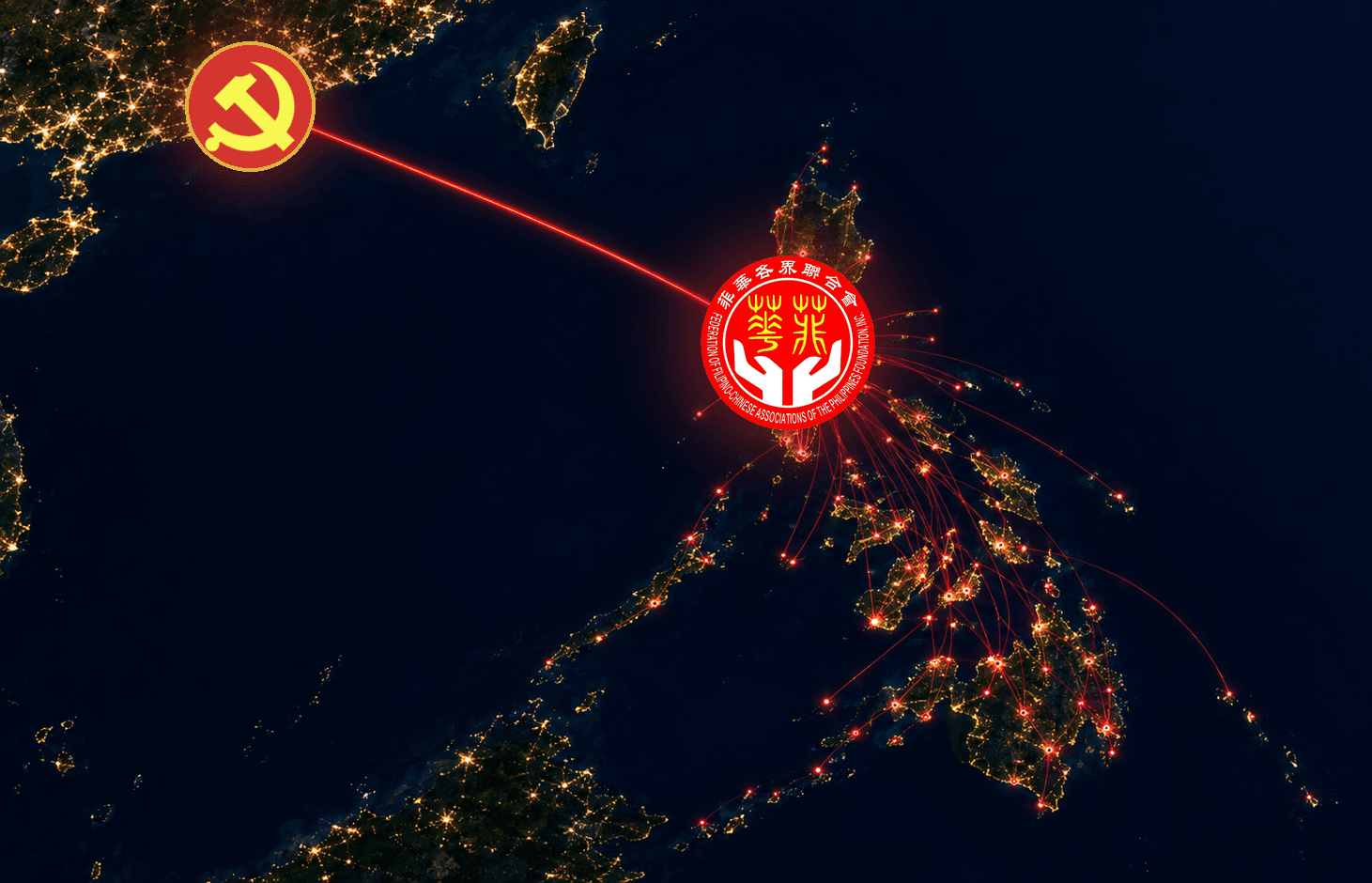
You've probably never heard of FFCAP; after all, nearly everything it publishes is in Chinese. China's embassy helped create it in 1977, two years after Manila and Beijing established diplomatic relations, and just last year it reaffirmed its pledge to work under the embassy's guidance. While its official filings tell Manila it exists to build "camaraderie," its true causes are Beijing's: above all, the "reunification" of Taiwan with the "motherland" and the loyalty of Filipinos of Chinese heritage. Three quarters of its trustees are declared Chinese nationals, and no public list of its members exists. Last year it gave a single gift two and a half times its reported annual income. This month it hosted a convention of Chinese community associations from across Southeast Asia, with Chinese Party-state officials on the dais.
Hosting a regional United Front gathering in Manila
On the evening of September 11 at the East Ocean Palace in Manila, the Federation of Filipino-Chinese Associations of the Philippines (菲華各界聯合會, or FFCAP) hosted the second annual convention of the Federation of ASEAN Fujian Associations. The theme was "Fujian Meets ASEAN, Creating and Sharing the Future." Delegations came from ten Southeast Asian countries, and Malaysia's Oriental Daily counted some 600 guests.
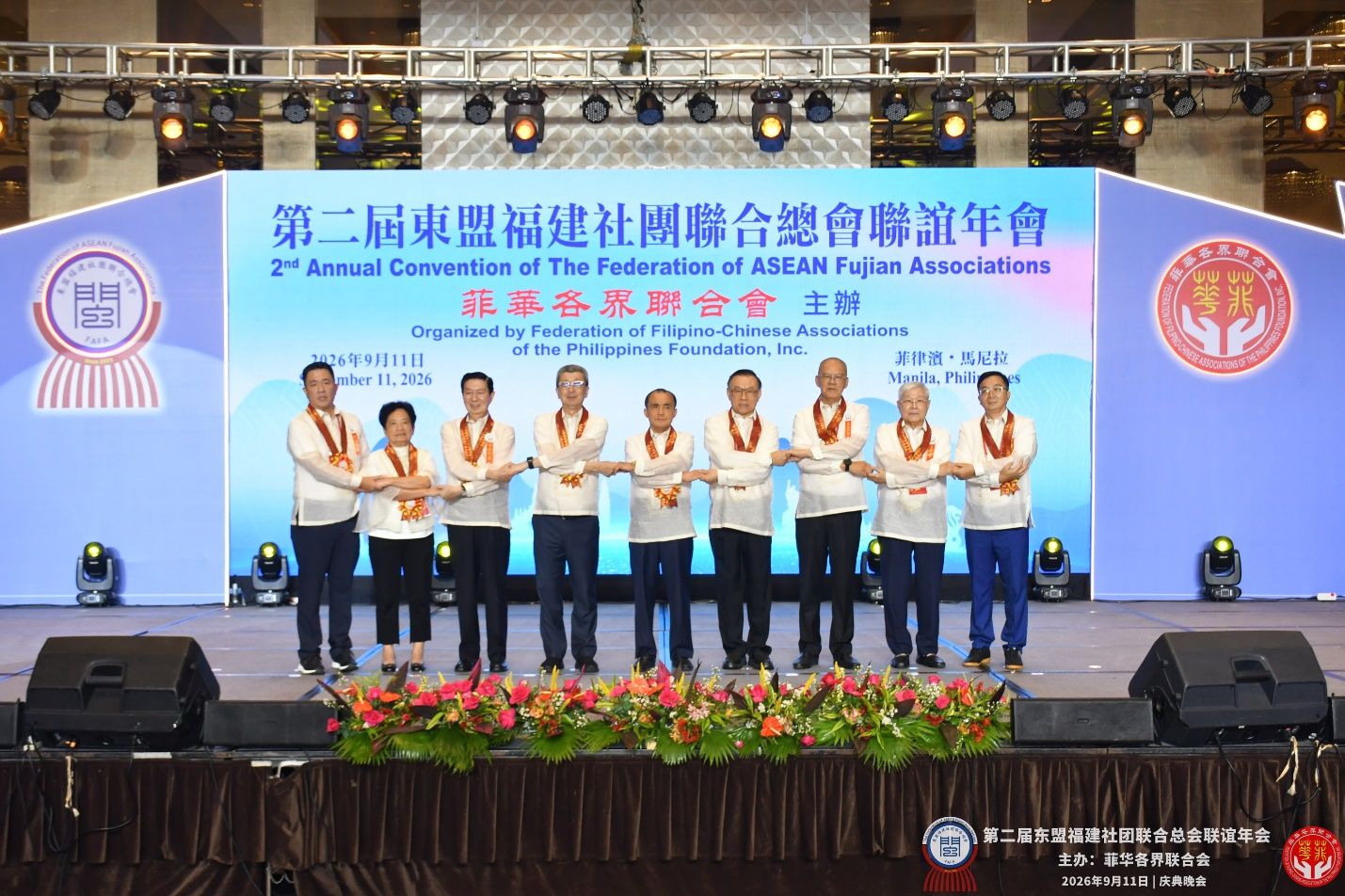
Wang Wei (王瑋), the Chinese Embassy's minister-counsellor and consul general, sat on the dais. So did Qi Zhi (齊志), vice chairman of the Fujian Federation of Returned Overseas Chinese, the provincial branch of what the Australian Strategic Policy Institute (ASPI) calls a peak United Front body for ethnic Chinese with overseas links.
United Front work is the Chinese Communist Party's (CCP) effort to influence and co-opt groups outside the Party and bring them under its leadership.
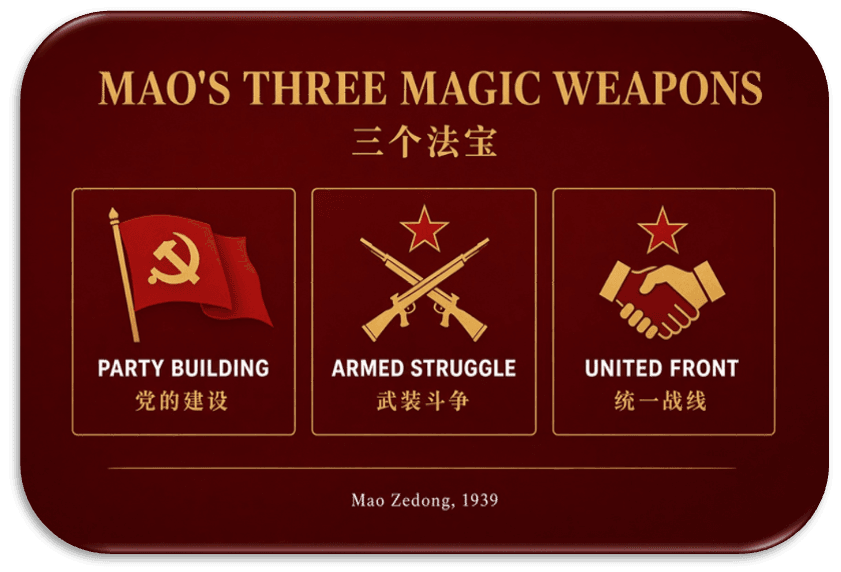
Mao called the United Front one of the CCP’s “magic weapons,” but today’s United Front Work Department (UFWD) is far more than a concept: it is a large Party bureaucracy with at least 12 central bureaus and a nationwide network of local Party organs. Abroad, ASPI assesses that the wider united-front system seeks to expand the CCP’s political influence, interfere in Chinese diaspora communities and help create a permissive international environment "building a permissive international environment for a takeover of Taiwan.".
So how did Fujian get involved in all this? It is the ancestral province of the great majority of ethnically Chinese Filipinos, and it faces Taiwan across the strait. The same ASPI study calls it "a hotbed of united front and intelligence work targeting Taiwan and the Hokkien-speaking diaspora." In 2023 the Party's Central Committee and the State Council jointly designated the entire province a demonstration zone for "cross-Strait integrated development." The province's overseas-Chinese apparatus serves diaspora management and Taiwan policy at once.
That's why it was Vice Chairman Qi who urged the ASEAN federation to "broadly gather the hearts, wisdom and strength of overseas Chinese," to serve as "vehicles for transmitting Chinese culture," and to "vividly tell China's story and Fujian's story."
In short, a PRC provincial Party-state official presented this assignment to Southeast Asian community leaders, at a gathering hosted by a Philippine federation that China's embassy helped create almost 50 years ago.
What exactly is FFCAP, and why does Beijing value it so highly?
In English, FFCAP is the Federation of Filipino-Chinese Associations of the Philippines, a club of clubs. Its Chinese name, the Federation of All Circles of the Philippine Chinese, claims to speak for every sector of the country's ethnically Chinese population.
By its own history, FFCAP was founded in 1977 "with the support and assistance of Mr. Ke Hua, China's first ambassador to the Philippines," and grew "with the vigorous support of the Chinese Embassy" to "more than two hundred patriotic member organizations."
What FFCAP says it does, however, depends on the audience.
In Chinese, FFCAP presents its mission as friendship, Chinese culture and "the complete reunification of the motherland," pursued in coordination with the embassy and Beijing's overseas-Chinese agencies. It frames this as support for "the Philippine government's 'One China' policy" (which nowhere asks for such support). The PRC Embassy adds that FFCAP exists to "unambiguously oppose 'Taiwan independence' forces."
In the face it presents to the Philippine government, FFCAP's political purpose can't be found. In its 2007 registration with the Securities and Exchange Commission (SEC) as Federation of Filipino Chinese Association of the Philippines Foundation, Inc., it gave its official purpose as merely promoting "good relations and camaraderie among Filipino-Chinese associations."
The broader Philippine public, meanwhile, barely hears from FFCAP at all. It has no web site and no social media presence in English or Tagalog; it speaks primarily through press releases to Manila's Chinese-language dailies and a publisher account in its name on Huaren Toutiao, a Chinese-language app run from Fuzhou.
When the Manila Standard covered its December 2025 courtesy call on the new ambassador, FFCAP pledged to "closely cooperate with the embassy to foster friendship." Its own Chinese-language dispatch on the same meeting was more specific, reflecting its pledge to "resolutely oppose any separatist acts" and work "under the guidance of the Embassy."
What FFCAP promises Beijing in Chinese it never gets around to mentioning in English or Tagalog.
FFCAP's audited accounts tell a more modest story still. For 2025 they reported just ₱590,000 of income (under $10,000, all from seven individuals), with ₱11,631 in current assets and no employees. Yet in September 2025 FFCAP handed the Federation of Chinese Schools ₱1.5 million (about $24,000) for its teacher awards. This is more than twice its reported annual income and appears nowhere we could find in its SEC filings. Its fifth such gift, in August 2026, brought the total over five years to ₱7.5 million.
On paper, the SEC oversees a ₱590,000 camaraderie club. In practice, this federation whose officers are sworn in by China's ambassador keeps both its mission and its money out of Philippine government filings.
Over 200 member organizations and counting
No publicly available roster of FFCAP's members exists in any language at all. The only sworn list, filed with its 2007 SEC registration, named eleven associations. These included a Fujianese merchants' chamber of commerce, hometown associations from Shishi and Nan'an, three Chinese fraternal lodges filed under "Mason" names, an athletic association and a Filipino-Chinese fire-prevention association in Caloocan.
Every later count of FFCAP's rapidly growing membership comes either from Beijing's own UFWD-linked organizations or from FFCAP itself. China's Overseas Chinese Affairs Office counted 108 in 2011, the All-China Federation of Returned Overseas Chinese counted 156 in 2018, and most recently FFCAP itself claimed more than 200 in 2025.
Number one on its 2007 sworn list is the Philippine Council for the Promotion of Peaceful Reunification of China (PCPPRC), filed at the same Binondo street address FFCAP used as its own registered office until 2025. The PCPPRC campaigns in the Philippines for Beijing's goal of bringing Taiwan under its rule. SeaLight has reported on its forums and propaganda since late 2025, while in The Diplomat journalist Frances Mangosing demonstrated its close links to the UFWD. PCPPRC's other ties to FFCAP are examined later in this article.
Taiwan is also FFCAP's core cause, and it campaigns on it in public. When Taiwan's opposition leader Tsai Ing-wen visited Manila in 2011, FFCAP -- claiming to represent its 128 member organizations -- warned her in five Chinese-language dailies that "any form of 'Taiwan independence' is a dead end." When US House Speaker Nancy Pelosi visited Taiwan in 2022, FFCAP pledged to "resolutely support" Beijing's "strong countermeasures," which began the next day with ballistic missiles fired into the waters encircling the island.
FFCAP also shares the host's podium at Chinese Embassy events attended by senior Philippine officials. This year's co-hosted June 9 Friendship Day gala drew nearly 4,000 guests, a congratulatory letter from President Marcos and a speech by a foreign affairs undersecretary. In February, First Lady Louise Araneta-Marcos attended a Chinese New Year reception co-hosted by FFCAP, the embassy and Manila's main Filipino-Chinese business federation, the FFCCCII.
In fact, Friendship Day itself exists partly thanks to FFCAP: China's state media credits it with pushing the Philippine government to officially declare it in 2002.
Sworn in by China's ambassador
When FFCAP marked its 48th anniversary in June 2025, China's ambassador was on hand to swear in its new board. Huang Xilian "served as the inducting officer for the new batch of officers" as the incoming officers raised their right hands. Officials from Guangdong's provincial overseas Chinese federation and Chaozhou's overseas Chinese affairs bureau came from China for the ceremony.
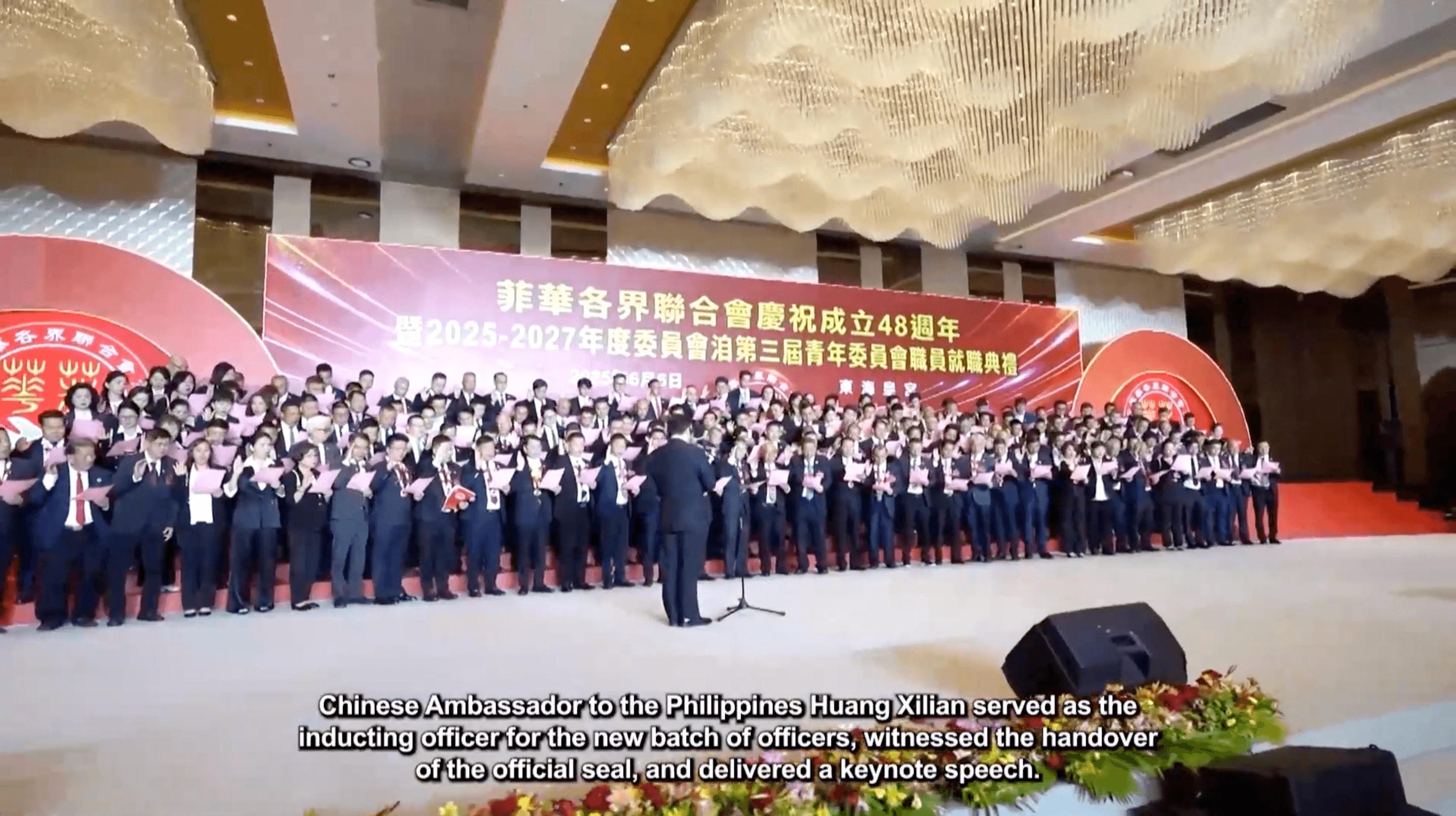
In his keynote, the ambassador praised FFCAP's contributions to "advancing the reunification of the motherland." Closing the evening, executive vice chairman Hou Zeqin (侯澤欽), whom FFCAP's SEC filings name as its president and chairman of the board, pledged the new committee to "the great cause of the reunification of the motherland." He credited FFCAP's 48 years to "the cordial care and guidance of the Chinese Embassy" and the support of China's overseas-Chinese affairs departments.
Six months later, FFCAP put the relationship in writing. Calling on the new ambassador in December 2025, FFCAP chairman Zhao Qiping pledged that the federation would work "under the guidance of the Embassy" as the "solid bridge between the Embassy and compatriots sojourning in the Philippines." To Beijing, which deliberately blurs the line between Chinese nationals abroad and foreign citizens of Chinese descent, a community rooted in the Philippines for generations is merely "sojourning" away from the motherland.
FFCAP's own leadership makes that description literal. Six of the eight trustees in its 2025 and 2026 SEC filings are declared Chinese nationals, including Zhao (whom Chinatown TV's English subtitles call Tiu Keeping and the filings list as Tiu Keeping Lin). The only two Filipino trustees are the secretary-treasurer and Hou, who for Philippine government purposes is listed as president and chairman of the board.
So here we have the body that claims to speak for every sector of the Philippines' ethnically Chinese community run mostly by PRC citizens, while even the Filipino who heads it on paper answers to a Chinese national.
Received at United Front headquarters
In November 2023, a 43-member FFCAP delegation was received at the headquarters of the Central UFWD by Chen Xu, a deputy head of the department who also ran the State Council's Overseas Chinese Affairs Office (OCAO). Then-chairman Dante Chua (蔡永寧) promised her FFCAP would "actively cooperate with the OCAO in carrying out its work."
Later that morning, at a banquet hosted by the China Council for the Promotion of Peaceful National Reunification, a UFWD-run body chaired by the CCP's fourth-ranking leader Wang Huning, council official Xiao Hong called FFCAP "the backbone force of anti-'independence' and pro-reunification work in the Philippines."
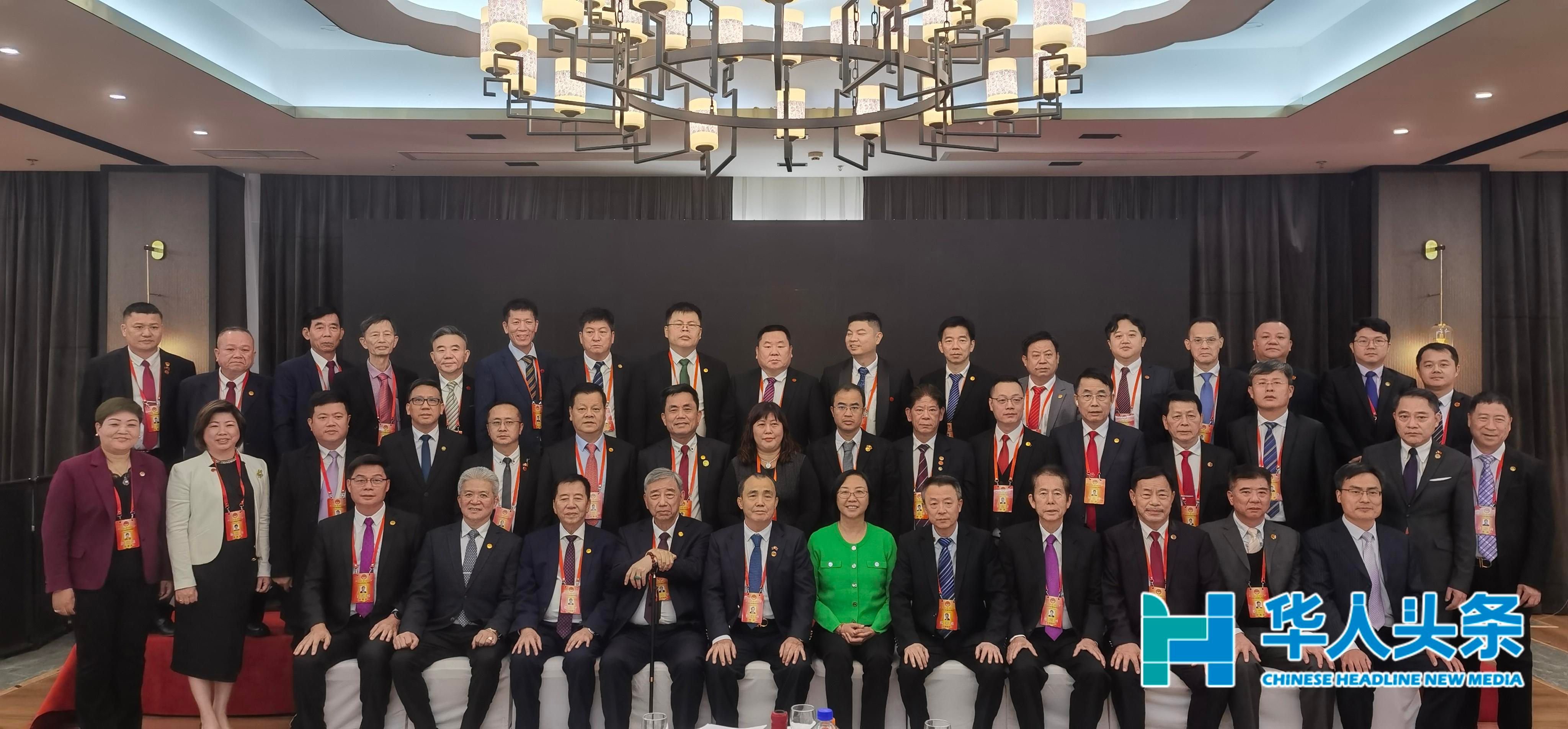
The Party has also come to FFCAP. In August 2022, Liu Jianchao, then head of the CCP's International Department, met FFCAP's leaders in Manila with the heads of five other community bodies, including the FFCCCII and PCPPRC. According to the Party's readout, they pledged to "promote the peaceful reunification of China and oppose 'Taiwan independence.'"
In April 2026, chairman Zhao Qiping (趙啟平) led a delegation to "more than ten overseas-Chinese-affairs units" in eight days. They included the All-China Federation of Returned Overseas Chinese, the China Overseas Friendship Association, the China Zhi Gong Party, the OCAO and Fujian's governor, who urged them to be "super-connectors." In July, Zhao attended a world conference of overseas Chinese associations in the Great Hall of the People, where UFWD head Li Ganjie addressed the opening and Wang Huning received the delegates.
Of the four United Front bodies that the Jamestown Foundation found active in the Philippines, FFCAP delegations have been received by three: the reunification council, the Overseas Friendship Association and the Zhi Gong Party.
PCPPRC: First on the list and at the head of the table
PCPPRC is more than FFCAP's first-listed member. It is the Philippine arm of the Beijing reunification council, and it shares FFCAP's founders: five of the nine incorporators who registered FFCAP with the SEC in 2007 had been PCPPRC founding directors. The two also shared more than a street address. FFCAP's registered office was Room 1108 of Binondo's Dasma Corporate Center, and in 2019 PCPPRC gave the same room as its secretariat.
In October 2018, Tsang Fook Yin (曾福應), then FFCAP's registered chairman of the board, attended the Beijing council's 30th-anniversary conference in the Great Hall of the People as an honorary president of PCPPRC.
Those deep ties persist. Seven of FFCAP's eight trustees hold office in PCPPRC's current leadership. PCPPRC's president, Cai Zhihe (蔡志河), a former FFCAP chairman and current honorary chairman, supplied 17 percent of FFCAP's reported 2025 income, more than anyone outside its board.
When Xiao Hong called FFCAP the "backbone force," she was describing a federation run largely by her council's own Philippine affiliate.
Fujian plays its "overseas-Chinese card"
The assembly FFCAP hosted on September 11 was that of the ASEAN Federation of Fujian Associations, a regional alliance founded in Kuala Lumpur in 2024. Fujian's UFWD sent a deputy head to its first congress. FFCAP took the rotating chairmanship in January 2026, with Dante Chua, FFCAP's immediate past chairman, as the federation's chairman.
On May 12, Chua was among the delegation at a meeting in Fuzhou with Fujian's provincial Party secretary, Zhou Zuyi (周祖翼). Zhou told them Fujian would "gather overseas-Chinese hearts, attract overseas-Chinese capital… and play well the new 'overseas-Chinese card' of the new era," and asked them to "assist in building the cross-Strait integrated development demonstration zone." Chua replied on the delegation's behalf that it would use "the influence of overseas Fujianese Chinese communities to promote the spiritual convergence of compatriots on both sides of the Strait." Four months later, the federation met in Manila, and Chua handed the flag to Thailand for 2027.
Watch this space: FFCAP at 50
Every government seeks influence abroad, and most of it happens in the open. What FFCAP's record shows is something quite different in scope, scale, intent and mendacity.
In July, Secretary of National Defense Gilberto Teodoro Jr. contrasted Philippine partnerships "based on fundamental freedoms, transparency, and the rule of law" with China's "sinister and cabalistic United Front Work." On September 26, he told a Manila news forum that Beijing uses the country's freedom of association to set up organizations that penetrate Philippine society.
More than two hundred associations sit under FFCAP's umbrella, and most are likely just what they appear to be. Filipinos of Chinese heritage deserve to live their lives free of manipulation by a foreign government and its domestic agents. At the same forum, Teodoro warned against "an atmosphere of xenophobia" and "bigotry," and said that if either takes hold, "it is because of what the Communist Party of China is doing worldwide."
The parties sorting Filipinos by ethnic heritage in this story are the officials who describe an ethnic group as capital to be attracted and a card to be played.
Next June FFCAP will turn 50. A celebration with the Chinese Embassy and various United Front officials is doubtless already being planned. Most Filipinos won't hear about it because it won't be reported in a language they understand.
If past is prologue, however, it will be gleefully reported in the press run by the Chinese government, the CCP and their in-country media mouthpieces.
And now we know where to look.