
The Philippine Teacher Recall: China Plays the "Safety" Card ... Again
Ray Powell
Share


On October 1, two Manila schools sent letters home to parents. Jubilee Christian Academy said its Chinese volunteer teachers had been "unexpectedly recalled by their sending organization," while Immaculate Conception Academy said the Federation of Filipino-Chinese Chambers of Commerce and Industry (FFCCCII) had told it that its Chinese teachers "need to return to China immediately." Neither letter gave a reason. That evening, a Chinese-language community portal reported the cause as "unknown".
By early the next morning, the number was 150, and reason was me.
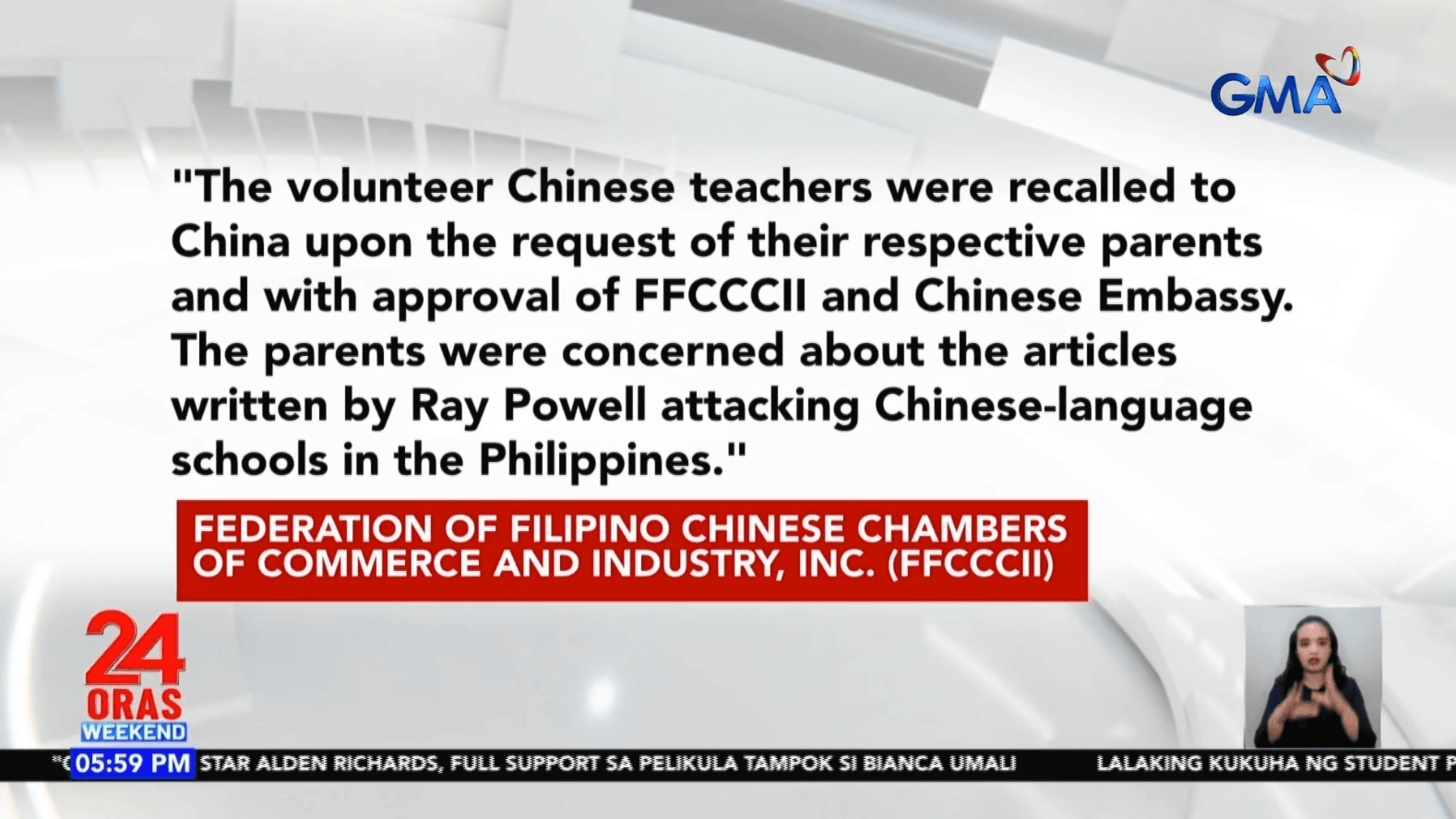
Chinese Commercial News reported that FFCCCII and the Philippine Chinese Education Research Center (PCERC), which has coordinated Chinese-language teaching in the Philippines since 1991, were sending about 150 Chinese teachers home. According to the paper, the teachers' families feared for their “safety” after Defense Secretary Gilberto Teodoro and I raised concerns about PRC-linked education programs, concerns both of us have tied to the Chinese Communist Party’s United Front Work Department.
The paper specified no teacher, family member or threat.
The Chinese Embassy then published a question-and-answer. As SeaLight pointed out, the Embassy wrote the question itself, and the claim about teachers' safety appears only in that question. The spokesperson's answer denounced "malicious smear campaigns" and urged Manila to "ensure that the safety and legitimate rights and interests of Chinese nationals in the Philippines are safeguarded." FFCCCII then told PhilSTAR Life that the teachers were recalled "with approval of FFCCCII and Chinese Embassy" because parents "were concerned about the articles written by Ray Powell."
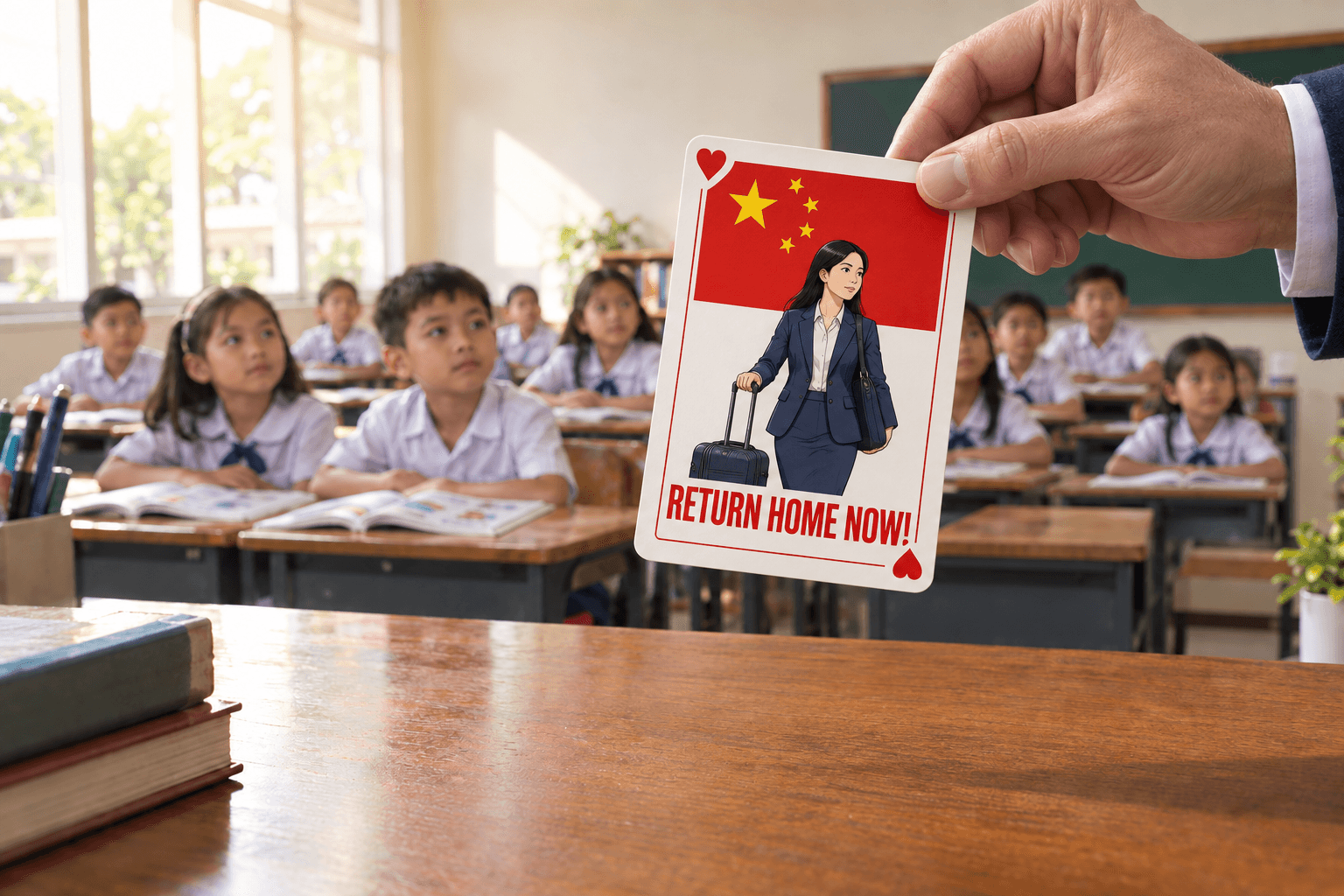
The "safety" card
When China wants to punish a government without saying so, it often claims its citizens are in danger. A warning like that costs nothing to issue and is hard to disprove. It threatens to drain tourists, customers, students or, in this case, teachers away from the target country, and it lets Beijing present itself as the protector and the target as the threat.
The Philippines has seen this before. During the 2012 Scarborough Shoal standoff, China's National Tourism Administration issued "travel safety advice," and Chinese travel agencies suspended tours to the Philippines. At the same time, Chinese quarantine officials turned away 150 containers of Philippine bananas they said were "crawling with insects." A researcher at the Chinese Academy of Social Sciences was candid about it: stricter fruit inspections were "convenient and easy to operate" and meant to "test the reaction of the Philippines before economic sanctions are introduced."
It happened again last year. In July 2025, China's Ministry of Education warned students considering the Philippines of "a surge in crimes targeting Chinese nationals," and the Foreign Ministry urged Manila to protect Chinese students' "safety, dignity and lawful rights and interests." On Aug. 30, days after Senator Panfilo Lacson alleged that Chinese sleeper agents were operating in the Philippines, Beijing reissued the study alert, citing an "unfavorable study environment," and added a travel advisory claiming that public security "has been unrestrained."
The Philippines isn’t alone. The "safety" card is one of Beijing's favorites. Just ask around:
South Korea, 2017. After Seoul agreed to deploy the THAAD missile-defense system, China's National Tourism Administration publicly reminded citizens to "clearly recognize the risks of outbound travel" and choose destinations carefully. Privately, its officials told travel agencies to cancel all group tours to South Korea or face fines. Lotte, which had provided the battery's site, saw its Chinese stores closed after fire-safety inspections.
Turkey, 2019. Three days after Turkey called China's treatment of Uyghurs "a great shame for humanity," the Chinese Embassy urged its citizens there to "pay attention to their personal safety." Two weeks later, Beijing closed its consulate in Izmir.
Australia, 2020. Weeks after Canberra called for an independent inquiry into the origins of COVID-19, China's Ministry of Culture and Tourism told its citizens "do not travel to Australia," citing racist violence. Days later the Ministry of Education warned students to be "cautious" about studying there. The warnings followed new Chinese tariffs on Australian barley and a suspension of imports from four major beef exporters. The Party's Global Times wasn’t subtle: Australia "must make a real change to its current stance on China, or it will completely lose the benefits of Chinese consumers."
Japan, 2025. A week after Prime Minister Sanae Takaichi spoke in parliament about a Taiwan contingency, Beijing told its citizens to avoid Japan because of "significant risks to the personal safety and lives of Chinese citizens." Two days later the Ministry of Education issued a study-abroad alert citing, without evidence, "a surge in crimes targeting Chinese citizens." Beijing demanded that Takaichi retract her remarks and then suspended Japanese seafood imports. As Jonathan Berkshire Miller of the Macdonald-Laurier Institute put it, Takaichi's remarks "provided Beijing with a usable pretext, but the antagonism predated them and would have found expression regardless."
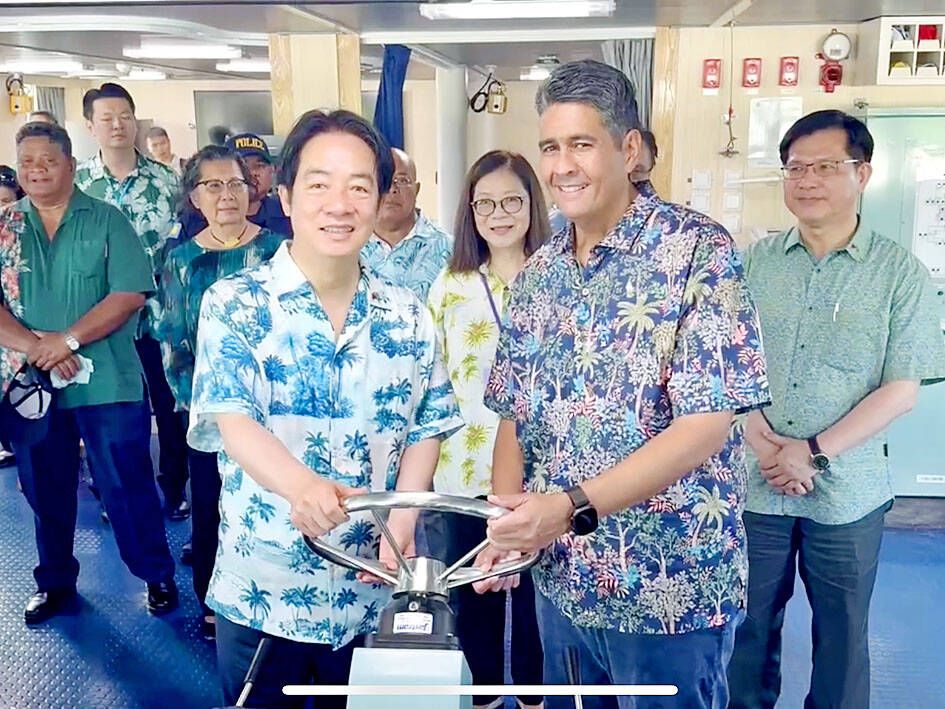
Palau, 2026. Palau recognizes Taiwan, and this year it hosted the Pacific Islands Forum with Taiwan’s delegation attending. On August 19, less than two weeks before the summit, China told its citizens to "exercise caution" in Palau, citing theft and robbery. At the summit, Beijing's special envoy, Qian Bo, was asked whether Taiwan would face consequences and said there would "always be consequences." Palau's president, Surangel Whipps Jr., put it plainly: "China continues to try to influence us, whether it's threatening us with weaponizing tourism or attacking us personally."
Every country has crime, racism and fire code violations. What turns them into a card is context: the danger appears when Beijing has a political grievance and tends to fade once the grievance is settled. It's announced through channels that look independent, like travel agencies, quarantine officers, a ministry's "reminder" or (in this case) "parents."
The "worried-parents" story
Here, too, the danger was asserted, not shown. No family or teacher has spoken publicly, and FFCCCII cited no specific threat or incident. The people supposedly endangering the teachers are the ones Beijing already wanted to punish. China sanctioned Teodoro in June, and in August the Party's tabloid Global Times called SeaLight a "cognitive-war platform." The decision was passed through a channel that looks like civil society, and it ended with the Embassy demanding that Manila protect Chinese nationals.
Yet there are indications that a drawdown of volunteer Chinese teachers in the Philippines was already well underway. China's 2027 volunteer-teacher position list, posted around September 22, ten days before anyone mentioned parents' fears, had no Philippine positions. Earlier lists advertised 45 Philippine posts for 2025, and then seen cuts to only 32 for 2026.
We don't know exactly who ordered the recall or when, but we do know that FFCCCII says the Embassy approved it, and that it is now being presented as the wish of the teachers' parents.
Institutions, not teachers
The safety story depends on a conflation. SeaLight has written about institutions: who trains the teachers, who sends them, who pays and who gives the direction. Beijing's messengers have responded as if we had accused the teachers.
A widely shared open letter to me from a well-known Chinese-Filipino content creator asked: "How else do you expect our students to learn Chinese if not from qualified, native-speaking teachers from China?" It's a fair question. We have no objection to teachers from China; our argument is about the state program behind them.
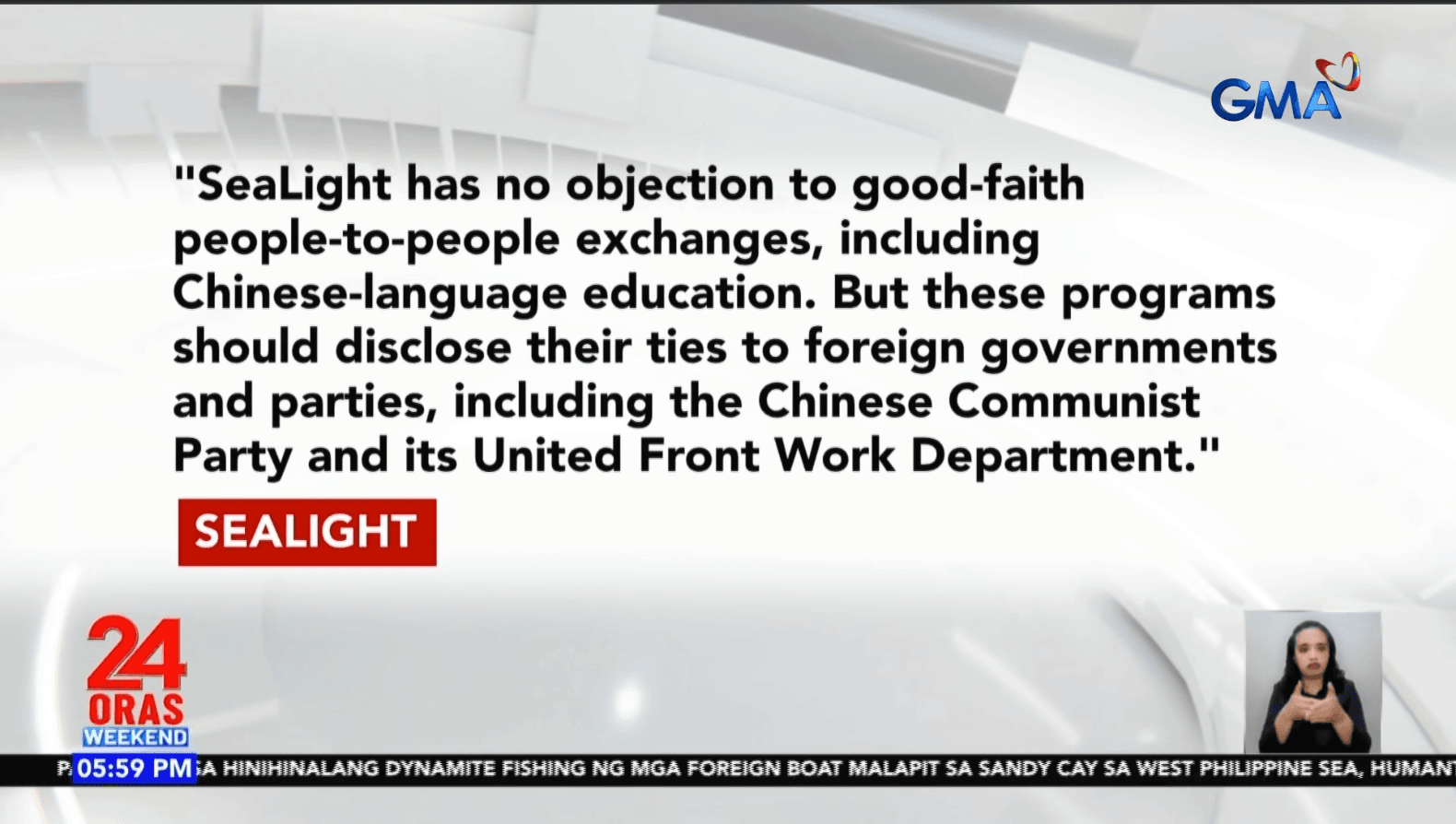
What we documented comes from the institutions' own records. Jinan University trained 43 of the 56 Filipino students in PCERC's 2024 teacher-training cohort, and it describes itself as "jointly constructed by The United Front Work Department of CPC Central Committee." PCERC's chairman, Huang Duanming (James Wang), has said returning graduates came home with "a strong sense of responsibility and ethnic identity." He has also listed the United Front Work Department and the Overseas Chinese Affairs Office among PCERC's collaborators, and in 2025 PCERC and the Philippine Council for the Promotion of Peaceful Reunification of China ran an essay contest for Philippine public-school students. The winners received their awards at a reunification forum where a Chinese diplomat called the one-China principle a "red line."
None of that is about a 24-year-old volunteer from China teaching tones to third-graders. All of it is about the Party-run system she has to operate within.
Who brought geopolitics into the classroom?
Beijing-based columnist Anna Malindog-Uy titled her column on the recall "Gibo's geopolitics marches into the classroom," but those who inserted geopolitics in the classroom wrote it into their own Party regulations.
The Chinese Communist Party's United Front Work Regulations assign overseas-Chinese work the task of "gathering overseas Chinese hearts, pooling their wisdom and bringing their strength into play" for the "Chinese Dream," and of cultivating overseas-Chinese representatives and resources for unification. In May, Fujian's Party secretary told a visiting Southeast Asian delegation, led by a Manila community leader, that his province would "play well the new 'overseas-Chinese card' of the new era."
In Beijing's own planning, Filipinos of Chinese heritage are a card to be played.
Playing that card puts the community at risk. In 2023, Angel Ngu, a former FFCCCII president then heading the United Front-linked Philippine Council for the Promotion of Peaceful Reunification of China (PCPPRC), pledged to make the Filipino Chinese community "a strong overseas base opposing 'independence' and promoting reunification."
Teodoro made the point last year: if there is sinophobia, "the overreach of the Chinese Communist Party and Xi Jinping causes this."
We've heard similar arguments at sea. Those of us who draw attention to China's aggressions in the West Philippine Sea are routinely cast as the provocateurs. Beijing and its proxies have spent years trying to discredit SeaLight. A China Daily-directed outlet called me "a vanguard of the U.S. military-industrial complex," and a China Media Group channel asked whether I was a "Maritime Expert or War Monger." Writing in The Diplomat, Jeffrey Ordaniel counted more than 200 uses of "provocation" in the Embassy's Facebook posts and concluded that the word "reverses causality."
Whoever turns on the light gets blamed for what's in the room. In the classroom version, whoever describes the United Front's education pipeline is accused of bringing politics into the schools.
The messengers
China's government didn't announce this recall itself. According to Chinese Commercial News, two Philippine organizations decided it, and one of them has spoken for it. The Embassy, state media and familiar commentators have stood squarely behind them.
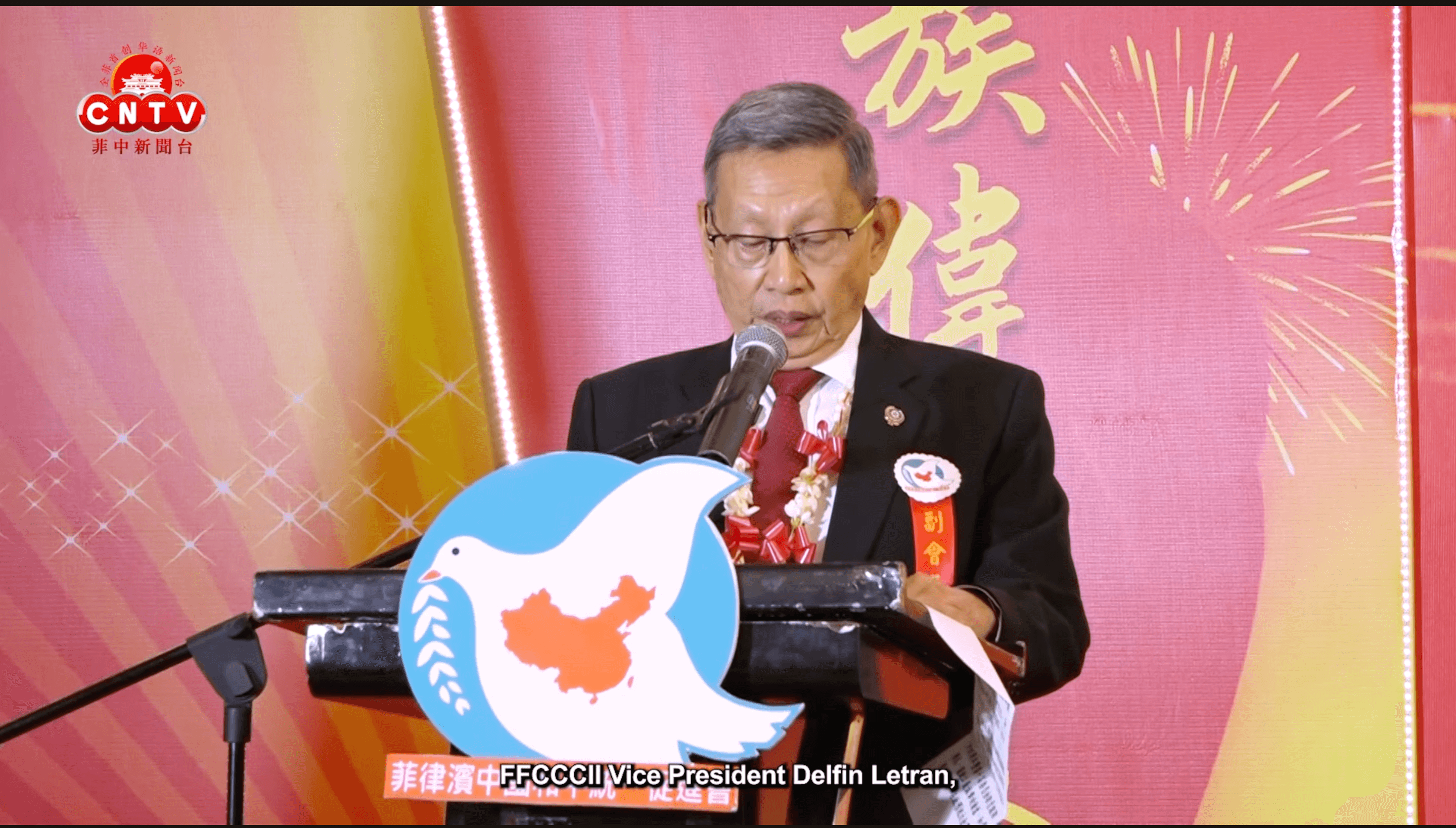
FFCCCII was founded in 1954 and has a real record of community work, including some 6,000 rural schoolhouses built since the 1960s. Its leadership is another matter. At least three of its current officers were named vice presidents of the PCPPRC in 2023, including the federation’s vice president who supervises its culture and education committee and the director who runs it. In September 2025, FFCCCII joined the United Front-linked Federation of Filipino-Chinese Associations of the Philippines "on behalf of the Chinese community" to contribute "selflessly to advancing the great cause of the reunification of the motherland." Three months later they promised the new ambassador to "work more closely with the Embassy."
When FFCCCII says the Embassy approved the recall, that fits the rest of the record.
Meanwhile, as we've documented, PCERC has run its teacher "blood transfusion" program with the United Front’s Overseas Chinese Affairs Office. Its chairman has been honored as a "Friend of the Chinese Embassy," and in April he gave the keynote at an Embassy ceremony where 31 education and employment agreements were signed.
No one in Beijing needed to write a script. The organizations delivering the message were already deeply enmeshed in its United Front work.
Who pays
As of this week, Chinese-Filipino children in Manila are learning Mandarin from substitutes and online classes. Nobody in the Philippine government asked the teachers to leave. Beijing, drawing on its United Front network, played its card. Now the community it claims to protect is paying for it.
FFCCCII says parents asked for the recall, but Beijing had already dropped the Philippines from next year's volunteer program before anyone mentioned parents. Whatever prompted these decisions, history strongly suggests they were made by political offices in Beijing, not by moms and dads.